

What if helping an aging parent make their will easier to find could also protect their privacy and independence? A will registry for aging parents records where a will is kept without asking family members to take control of the document or its decisions.
A parent may not want to discuss future planning, and relatives may be unsure how to raise the subject. The goal isn’t to pressure them or ask to read private documents. It’s to let them choose what location information to record, who may access it, and when access becomes available.
This article explains how to start a respectful conversation and create a clear, current record of the will’s location. You’ll learn how a location record differs from digital document storage, how to designate searchers and notification recipients, and how activation dates control access and notifications. Locate My Will is a paid subscription platform for recording a will’s location, with access limited to verified searchers.
Key Takeaways
- Start with your parent’s preferences, and let them decide what to share and with whom.
- Understand what a will registry for aging parents records and how it works alongside the original signed document.
- Compare a conversation, a family note, and an online registry to choose a location plan that fits your family.
- Use a simple process to confirm the will’s location, choose authorized people, and keep the record current.
- Learn how authorized searchers, notification recipients, and activation dates support a permission-based plan.
Will Registry for Aging Parents: Start With Their Wishes, Not Their Age
Wanting to help an aging parent make their will easier to find is a practical expression of care. Begin with their preferences, not assumptions about what they need. A parent’s age, diagnosis, or disagreement with relatives doesn’t, by itself, establish that they can’t make their own decisions. A will registry for aging parents is an option for the parent to consider and direct.
Keep the purpose narrow: identify where the will is kept, not ask to read it. A parent may be comfortable sharing the location with one trusted person while keeping the document’s contents private. A general overview of wills and testaments can clarify what a will is. The family’s immediate task is to agree on how its location should be found when needed.
How to raise the will-location conversation gently
Choose a calm, private moment, rather than raising the subject during an argument, health scare, or urgent family decision. Ask what planning your parent has already completed, then explain the practical reason for talking: reducing confusion about important paperwork later. Open questions make room for their preferences and help keep the conversation from feeling like a demand.
- “Have you already decided where important documents should be kept?”
- “Who, if anyone, would you want to know where your will is?”
- “Would you prefer to keep that information in a note or use another approach?”
Listen before suggesting a solution. If your parent has already made arrangements, ask whether they want to share the location or keep it private for now. You don’t need to settle every planning question in one conversation.
Keep the parent in control of the plan
Let your parent decide whether to participate, what location details to share, and which people to involve. Permission to know where the will is kept is not permission to inspect it. Keeping those decisions separate can protect privacy while still allowing the family to make a practical plan. If the discussion shifts toward inheritance, family roles, or past disagreements, return to the narrower question of where the document is kept.
Family members may disagree about who should be informed, but that doesn’t transfer decision-making authority to the loudest relative. Ask your parent what feels appropriate, and don’t make commitments on their behalf. If they aren’t ready, pause without pressure and leave the door open to revisit the subject later.
The parent should decide what to share, and with whom. That principle keeps the plan centered on the person whose wishes and document it concerns. A respectful conversation can end with a clear next step or an agreement to talk another time. Either outcome preserves the parent’s choice.
What a Will Registry for Aging Parents Records, and What It Does Not
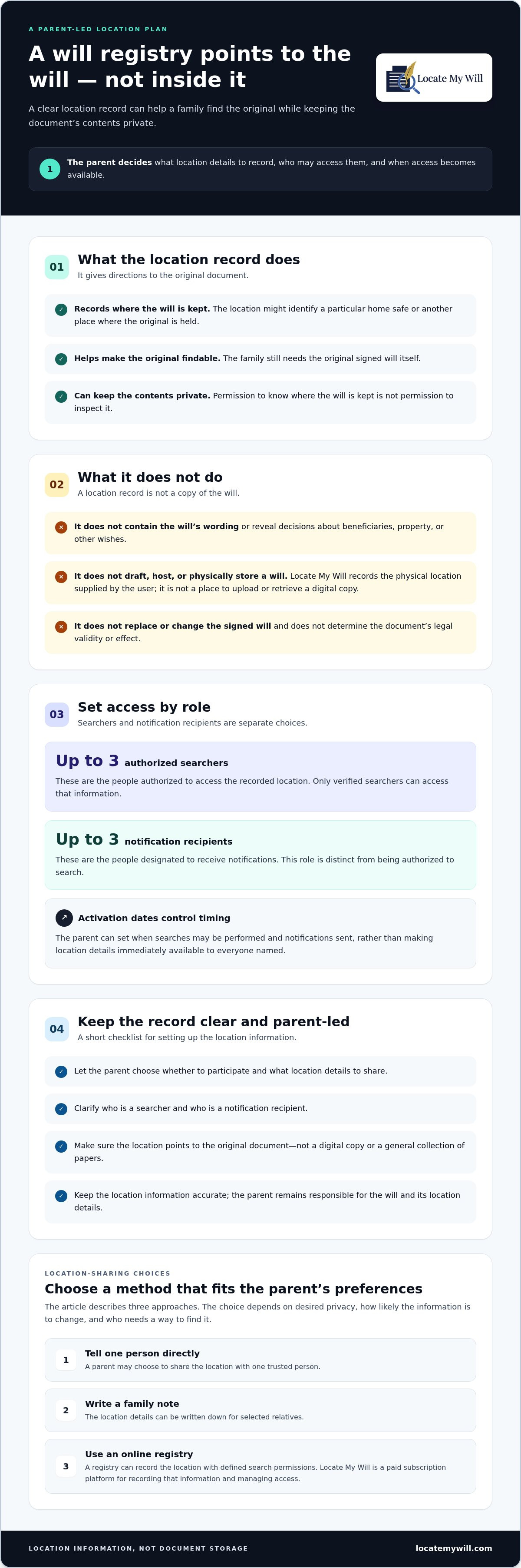
A will-location registry records directions to a will, such as where the original paper document is kept. It doesn’t contain the will’s wording or give someone permission to review it. A parent can make the document findable without sharing private decisions about beneficiaries, property, or other wishes.
A location registry records directions to a document, not its contents. The parent supplies the location information and chooses which people, if any, may search for it. For example, the record might point to a particular home safe or identify another location where the original is held. The family still needs the original document itself.
A location record complements the original signed will; it doesn’t replace it. AARP’s Retirement Checklist includes estate-planning considerations for older adults, including making important documents accessible. A will registry for aging parents can organize location information while leaving the document and its contents where the parent chose to keep them.
A location record is different from digital will storage
Locate My Will records the physical location supplied by the user. It doesn’t draft, host, or physically store wills. The service records where a document can be found; it isn’t a place to upload or retrieve a digital copy.
This distinction helps families decide what to share. A location record can identify where the will is kept without revealing its contents. It doesn’t alter the document or determine its legal validity or effect. The parent remains responsible for the will and for keeping the location information accurate.
How access permissions and activation dates work
The parent can designate up to three authorized searchers and up to three notification recipients. These are separate roles: searchers are authorized to access the recorded location, while notification recipients are designated to receive notifications. Only verified searchers can access the location information, so access is limited to people authorized for that role.
Activation dates control when searches can be performed and notifications sent. The parent can set the timing as part of the plan rather than making location details immediately available to everyone named. Before recording the location, clarify who has each role and ensure the description points to the original document, not a digital copy or a general collection of papers. Locate My Will’s will-location platform provides a paid subscription service for recording that information and managing access.
Compare Ways to Help Aging Parents Make a Will Findable
There isn’t one location-sharing method that suits every family. A parent may prefer to tell one person directly, write down the details for selected relatives, or use an online registry with defined search permissions. The right choice depends on the privacy they want, how likely the information is to change, and who needs a way to find it.
Compare the practical trade-offs before choosing. A will registry for aging parents is one option, not a requirement. A personal arrangement may be enough if it reflects the parent’s wishes and someone keeps it current.
| Approach | Privacy | Ease of updating | Who can access location details |
|---|---|---|---|
| Direct conversation | Can be limited to the people the parent tells. | Requires telling recipients again if details change. | People who receive the information directly. |
| Written family note | Depends on where the note is kept and who can see it. | The parent can revise or replace it, but recipients need the current version. | Anyone with access to the note or a copy. |
| Online location registry | Can use designated search permissions and activation dates. | Location information can be maintained in the registry. | Authorized, verified searchers, according to the registry’s access controls. |
When a direct conversation or family note may suit
Direct sharing can work when a parent wants a simple, personal plan, such as telling one trusted relative where the will is kept. A written note can preserve the details without relying on someone’s memory. In either case, the parent should choose who receives the information and where any note is kept.
The main trade-off is upkeep. If the will moves or the parent wants a different person informed, a conversation or note can become outdated. Agreeing on who will receive updates helps keep an informal plan useful.
When a permission-based registry may fit
A registry may suit a parent who wants location details organized separately from the will and access limited to selected people. For broader context on the role of registration, see this online will location registration guide. The key question is whether the approach reflects the parent’s preferences, not whether every family needs a registry.
With Locate My Will, the parent can designate up to three authorized searchers and three notification recipients. Only verified searchers can access the location information. Activation dates control when searches can occur and notifications can be sent. These controls offer a structured alternative to relying on a note that may be copied or misplaced, while leaving the parent to decide who is included and when access begins.
Whichever approach the family chooses, decide how the location details will be kept current. Review them when the document moves or the parent changes their chosen contacts so the plan doesn’t point to outdated information.
Set Up and Maintain a Parent-Led Will Location Plan
A reliable plan starts with the parent’s choices and stays useful only if its details remain accurate. Treat it as a short administrative task, not an invitation to inspect the will. Organizing other estate documents can also help the family see how this location record fits alongside important paperwork.
- Agree on the plan. Ask your parent whether they want to record the will’s location and how they’d prefer to do it. Confirm that the goal is to help selected people find the document, not to review its contents or discuss who inherits what.
- Identify the current location. Have your parent confirm where the will is actually kept. Use a description that distinguishes it from other papers, such as naming the relevant safe or clearly identified folder, without adding unnecessary details.
- Select authorized people. Let your parent decide who may search for the location and who should receive notifications. These roles can be assigned to different people. Review each choice with the parent instead of assuming close relatives should automatically have access.
- Record the details. Use the agreed method and include only the information needed to find the document. Have your parent check the location description before it is saved or shared.
- Review the plan. Revisit the location and access choices after a move, a change to the will, or a change in trusted contacts. A brief review can prevent the record from pointing to an old storage place or naming someone the parent no longer wants to authorize.
Record only the details needed to find the document
Make the description specific enough to guide an authorized person, but keep it focused. Naming a particular locked cabinet is more useful than writing “somewhere at home.” Don’t copy the will’s contents into the location record. A note shared casually with a broad family group may travel further than intended, so the parent should choose recipients and a sharing method carefully.
Review access and location details over time
A record can become outdated if the will is moved, replaced, or stored differently. Ask the parent to review both the location and the people named for access or notifications when circumstances change. Keep those decisions parent-led, including whether to add or remove a contact. For a separate overview of later search steps, consult this guide to finding a deceased person’s will.
A will registry for aging parents can organize location details and manage selected searcher permissions. If your parent chooses that approach, record the will’s location with Locate My Will through its paid subscription platform. The parent remains responsible for confirming the location and deciding who receives access.
How Locate My Will Supports an Aging Parent’s Chosen Plan
When a parent wants a formal way to record their will’s location, Locate My Will offers an online, subscription-based option. The parent decides whether to participate, what location details to record, and who to designate for access. The platform helps make the location findable; it doesn’t replace the family conversation about the parent’s wishes.
The platform records where a will is kept, not the will itself. It doesn’t draft wills, physically store documents, or provide legal advice. The parent keeps the document in their chosen location and is responsible for ensuring the record points to it.
A structured record with defined access
Through an online account, the will owner records the will’s physical location and selects people for specific roles. Users can designate up to three authorized searchers and up to three notification recipients. Only verified searchers can access the recorded location, so the information isn’t open to everyone in the family.
Searchers and notification recipients serve different purposes. The parent chooses who may look up the location and who should receive notifications. This structure can suit families who want a permission-based alternative to relying only on a paper note or a relative’s memory. A will registry for aging parents remains a choice, and the parent should decide whether it fits their plan.
Choose the next step together
Before setting up an account, review the arrangement with your parent. Confirm that they want to record the location, understand who they’re designating, and are comfortable with how access is controlled. If they’re uncertain, there’s no need to rush. The platform should support their plan, not determine it.
Activation dates control when searches can take place and notifications can be sent. Discuss timing as part of the parent’s access choices, and update the location information if the will or its storage place changes. These settings control access to the location record; they don’t change the will or guarantee what happens later.
If the parent chooses an online registry, Locate My Will provides a way to record location information through a paid subscription. Review the platform together, including its location-only role, designated searchers, notification recipients, and activation dates. If it fits the parent’s preferences, explore Locate My Will’s will-location registration and decide together whether it belongs in the family’s plan.
Make the Next Step a Shared Decision
A thoughtful plan doesn’t have to be completed in one conversation. Your next step can be as simple as asking your parent whether they’d like to revisit the subject and choose a time to decide what feels right. That keeps the process collaborative without pressuring them to share more than they want.
A will registry for aging parents is most useful when it reflects the parent’s choices and can be updated as those choices change. Let them set the pace, ask questions, and decide whether an online location record belongs in their plan. Even a decision to wait gives your family a respectful place to begin.
Explore Locate My Will and make a will-location plan together. Start with a calm conversation, then use the platform to record the location and manage designated access if your parent chooses an online registry.
Frequently Asked Questions
Is a will registry appropriate for every aging parent?
Not necessarily. A will registry for aging parents is one way to record a will’s location, but a conversation or written note may suit a parent better. The useful test is whether the parent approves the plan, including who can access the information. For example, they may prefer to tell one trusted person directly. Discuss privacy boundaries and how to keep the details current before recording anything.
Can an adult child register a parent’s will without their permission?
No. The parent should decide whether to record the location and who may access it. An adult child can offer to explain the choices or help with the steps if invited, but being related doesn’t by itself grant permission. If your parent agrees to help, let them lead decisions about the information and designated contacts. If they decline, respect their decision rather than creating a record on their behalf.
What information should a family share about a parent’s will?
Share only what the parent agrees is necessary for the plan. Someone may need to know that a will exists and how to locate it without knowing who inherits particular assets. For instance, the parent could give a chosen contact the location instructions while keeping the contents private. Agree on who receives updates, and revisit the arrangement if the storage place or authorized contacts change.
What happens if an aging parent moves the will after recording its location?
The existing details may no longer lead to the document, so the parent should update the record after moving it. Review the location when they reorganize important papers or change where they keep the original. If the will can’t be found later, a location record cannot substitute for it; the family may need to follow the estate process that applies to their circumstances.
How many people can be authorized to search through Locate My Will?
A user can designate up to three authorized searchers and three notification recipients. The roles are separate, so a parent might choose one person to search and different people to receive notifications. Only verified searchers can access the location information. When making selections, consider who can use the instructions and whether each person should remain included when the plan is reviewed.
Does a will registry store or create my parent’s will?
No. Locate My Will records where a will is kept; it doesn’t create, host, or physically store the document. The parent’s original remains in the location they choose, and the location record doesn’t determine the will’s legal effect. Keep the document and its location instructions conceptually separate so family members understand what the record can point them toward and what it cannot provide.
When can authorized searchers access a will’s location in Locate My Will?
The user’s activation dates determine when searches can be performed and notifications can be sent. The parent should choose the timing deliberately and consider whether the dates reflect the plan they intend. Search access is limited to verified, authorized searchers. These controls govern access to the recorded location information; they don’t establish who has legal authority over the will or estate, so registry access shouldn’t be treated as a substitute for that authority.


