

What good is a carefully prepared will if the people who need it can’t find it? Knowing how to ensure family can find your will isn’t about sharing every private detail. It’s about making sure the right people know where to look when the time comes.
You can keep your wishes private while helping family or the person expected to act avoid confusion. Make a plan that records where the will is kept, identifies who may access that information, and stays current when storage arrangements or contact details change.
This guide explains what to record, who to authorize, and when to review your plan, without broadly disclosing the contents of your will. A location registry such as Locate My Will can complement your physical will by recording where it’s kept and controlling when verified searchers can access that information. It doesn’t host or physically store the will. The aim is a private, orderly plan that tells the right people where to begin.
Key Takeaways
- To learn how to ensure family can find your will, create a current location plan that names where the signed document is kept and who can help locate it.
- Distinguish the current signed will from drafts, and record its location in instructions that are easy to update.
- Compare a conversation, private written instructions, and an online location record by considering privacy, access, and how each can be updated.
- Review your plan after a move, document update, storage change, or change in the people you’ve chosen to contact.
- Locate My Will lets you record the will’s location, designate up to three authorized searchers and three notification recipients, and set search activation dates.
Why a will can be hard for family to find, and what a location plan solves
A valid will can’t guide decisions if nobody knows where to look. Even a well-prepared document may be overlooked if it’s kept somewhere unexpected, the location instructions are outdated, or family members can’t distinguish the current version from an older copy. A practical answer to how to ensure family can find your will is to plan for discovery separately from preparing the document itself.
A will-location plan is a current set of instructions that identifies where a will is kept and who can help the appropriate people locate it. It can reduce guesswork without requiring you to disclose the will’s contents widely. A Will and testament sets out a person’s wishes for what happens after death; a location plan simply helps people find the document.
What information should family be able to find?
Focus the instructions on locating the will, not on its private details. Record whether a will exists, its date or another clear identifier, where it’s kept, and any necessary access instructions. Name an appropriate contact who can help guide the search. For example, “signed will dated [date], kept in [location]; contact [person] for access instructions” is more useful than “the will is at home.”
Make the version clear. If drafts or older copies remain, label them so they can’t easily be mistaken for the current signed document. The aim is to point people to the right document, not to summarize its provisions.
Why location instructions are different from the will itself
A location record points to a document; it is not the document. An online record doesn’t create, revise, or validate a will, and it doesn’t determine how the document should be interpreted or how an estate should be distributed. Those are separate legal matters, and requirements for wills vary by state.
This distinction helps set clear expectations. Locate My Will records where a will is kept; it doesn’t host the will or physically store it. Users can designate up to three authorized searchers, who must be verified before they can access the recorded location information. That controlled access helps keep instructions available to selected people without making the will’s contents broadly accessible.
Finding the document is an important practical step, but it doesn’t establish whether the will is legally valid or resolve questions about its meaning. A location plan addresses a narrower problem: helping the right people know where to start looking.
Build a private, reliable plan for where your will is kept
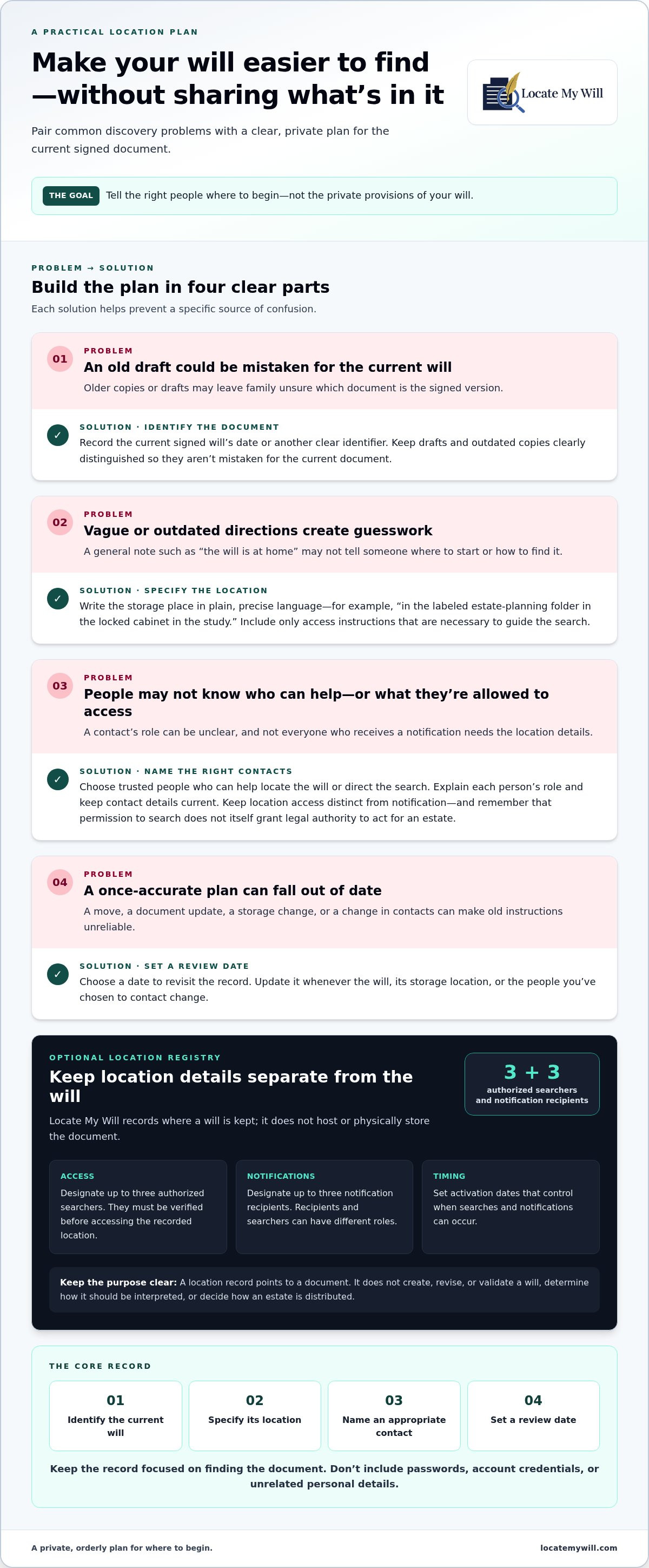
Build a dependable location plan in four steps: identify the current will, record where it’s kept, choose appropriate contacts, and set a date to review the information. Each step matters. If the record points to an old draft or a place you no longer use, it may create more confusion instead of less.
Start by identifying the signed document you consider current. Note its date or another clear identifier, and separate drafts or outdated copies so they can’t be mistaken for it. Then describe the storage location precisely. “In the home safe” may not be enough if there’s more than one safe or someone else needs to know where to begin. Practical guidance from Charles Schwab also emphasizes planning where to store originals and ensuring the right people know how to locate important documents.
Core record checklist: identify the document, specify its place, name a contact, and set a review date. Use this as the foundation for how to ensure family can find your will while keeping its provisions private.
Record the location without exposing private details
Write the instructions in plain language, such as “in the labeled estate-planning folder in the locked cabinet in the study.” If someone needs a particular access step, include only what’s necessary to guide them. Don’t put passwords, account credentials, or unrelated personal details in notes that may be shared more widely than intended.
Telling someone where a document is kept is different from sharing what it says. A location note can identify the will and point to its storage place without summarizing beneficiaries, gifts, or other private provisions. Keep the record focused on finding the document.
Choose who should know and what role they have
Select trusted people who can help locate the will or direct the search. Explain each person’s role and keep their contact details current. Not everyone who receives a notification needs access to location information. Likewise, permission to search for a recorded location doesn’t by itself grant legal authority to act for an estate.
Locate My Will lets users distinguish authorized searchers from notification recipients. Users can designate up to three of each. Searchers must be verified before accessing the recorded location, and activation dates control when searches and notifications can occur. This provides an organized way to maintain location instructions for selected people. To keep a will’s location record separate from the document itself, record your will’s location.
Choose a review date, then revisit the record whenever the will, storage place, or designated contacts change. A scheduled check can help keep instructions aligned with your current arrangements.
Compare family instructions, a private record, and an online location registry
No single method suits every family. A conversation can make sure someone knows a will exists, a private written note can preserve precise instructions, and an online location registry can organize details for authorized people. These methods can also work together, providing useful reminders without requiring you to share the will’s contents widely.
| Method | Access | Privacy | Updateability | Dependence on remembered instructions |
|---|---|---|---|---|
| Direct conversation | Available to the people you tell | Depends on whom you tell and what you share | Requires you to tell people about changes | Higher, since people may forget details |
| Private written instruction | Available to people who can locate the note | Can be kept private, depending on where it’s stored | Requires replacing or revising the note | Lower if the note is found, but someone must know where it is |
| Online location registry | Controlled by the registry’s access process | Can limit location access to authorized, verified searchers | Location and contact details can be maintained through the record | Less reliant on someone recalling verbal directions |
When a conversation or written instruction may be enough
A brief conversation with a trusted person can establish that a will exists and explain where to begin looking. A written instruction gives them a reference to consult later. Both are useful, but spoken details can fade from memory, and a note can become outdated after a move or storage change. If the location or contacts change, update the instructions and let the relevant people know.
What a controlled online location record adds
A registry provides an organized place to record where the will is kept and who may search for that information. Locate My Will lets users designate up to three authorized searchers and up to three notification recipients. These roles are distinct: receiving a notification doesn’t automatically make someone an authorized searcher. Searchers must be verified before accessing location information, and activation dates control when searches and notifications can occur.
A registry records location information; it doesn’t hold the physical will or the digital document. It can complement a conversation or private note rather than replace either. Learn more about will location registration.
Keep your will easy to locate as people and circumstances change
A location plan is useful only if it still reflects your arrangements. A move, a new storage place, an updated will, or a change in the people you’ve named can make old instructions unreliable. If you’re considering how to ensure family can find your will, maintaining the plan is part of the process.
Review your location instructions whenever the document, its storage place, or your designated contacts change. Treat updates to the will and updates to its location record as separate tasks. Making or replacing a will doesn’t automatically update a record that points family toward an earlier version or an old location.
What should prompt an update?
Use these changes as reminders to check your record:
- Moving: Confirm that the location description still leads to the correct place.
- Changing storage: Update access instructions if you move the document to a different safe, cabinet, or other location.
- Making or replacing a will: Check that the record identifies the document you want people to look for. This is a location-record check, not a legal review of the will.
- Changing contacts: Update details if a selected person is no longer appropriate, has new contact information, or can’t be reached.
After an update, confirm that each selected person still understands their role. Someone who can help locate information may have a different role from someone who receives a notification. Keep those distinctions clear and contact details current.
How to confirm the plan works without oversharing
Test the instructions with a trusted person by asking whether they can follow them to identify where the will is kept. You don’t need to share or discuss the will’s contents. If the person isn’t sure where to start, make the directions more precise.
For an online location record, review the authorized-searcher details and notification preferences too. Locate My Will supports up to three authorized searchers and three notification recipients. Searchers must be verified before accessing the recorded location, while activation dates control when searches and notifications can occur. Review these settings when people or circumstances change.
Keeping the record current can help prevent uncertainty about where to begin. For more context, read about the consequences of a lost will. To organize and maintain your will’s location information, record your will’s location with Locate My Will.
Put your family’s will-location plan in place with clear next steps
A clear plan doesn’t need to be complicated. Confirm which will is current, record where it’s kept, choose who should receive information or help locate it, and schedule a review. These steps turn preparation into practical instructions while keeping the will’s contents private.
A final checklist before you finish
- Confirm the document: Identify the current will by its date or another clear reference.
- Check the location: Make sure the description points to the document and includes only necessary access instructions.
- Review the people: Confirm that selected searchers and notification recipients still reflect your wishes and have current contact details.
- Set a reminder: Review the record after changes to the will, its storage location, or designated contacts.
Keep these tasks separate. Updating a will and updating the instructions that point to it are different steps. If the document changes, check that the location record still identifies the version you want family to find.
How a will-location registry supports the plan
Locate My Will gives users a way to record where their will is kept and manage who may access that location information. Users can designate up to three authorized searchers and three notification recipients. These roles are separate, and searchers must be verified before accessing the record. Search activation dates control when searches and notifications can occur, helping manage access rather than making location details openly available.
The registry records the will’s location. It doesn’t upload or host the digital document, physically store the will, or draft legal documents. It supports the location plan; it doesn’t determine whether a will is valid or guarantee a particular legal or probate outcome.
To organize your family’s location plan, set up a will-location record.
If someone is already looking for a will, a location plan is only one part of the process. Follow a systematic guide to finding a deceased person's will for practical search steps.
Make your will-location plan part of your preparations
A will can guide the people who need it only if they can find the right document. Identify the current will, record its location without sharing private contents, choose appropriate contacts, and review the details when circumstances change. That’s how to ensure family can find your will while keeping access intentional.
Locate My Will provides an organized way to record where the will is kept. Users can designate up to three authorized searchers and three notification recipients. Searchers must be verified before accessing location information, and activation dates control when searches and notifications can occur. The record complements the will; it doesn’t store or draft the document.
Start with a clear, current location record and keep it aligned with your arrangements. Create a secure record of where your will is kept with Locate My Will, and give your family clearer direction.
Frequently Asked Questions
How can I make sure my family knows where my will is?
To understand how to ensure family can find your will, identify the current signed document, record its location clearly, and tell trusted people how they can access the instructions. Include the will’s date or another identifier, where it’s kept, and a relevant contact. Keep the record current after changes to the document, storage location, or contacts. A location registry can organize this information for authorized searchers.
Should I tell my family where I keep my will?
Consider telling at least one or two trusted people that a will exists and where they can find the location instructions. You don’t need to share the will’s provisions or discuss private decisions. A brief conversation can make family aware of the plan, while a written or online location record provides a reference if details are forgotten. Choose people who can be reached and understand the role you’re asking them to play.
Is it safe to record my will's location online?
An online location record can help keep instructions organized and limit access to designated people. Locate My Will lets users name up to three authorized searchers, who must be verified before accessing recorded location information. Activation dates control when searches and notifications can occur. Keep the record focused on location details rather than the will’s contents or unnecessary personal information, and review its access settings as needed.
Can a will location registry store or replace my will?
No. A will location registry records where the will is kept; it doesn’t store the physical document or host a digital copy. It also doesn’t create or revise a will. Keep the will itself in its chosen place and use the record as a pointer to that location. The registry complements your document and helps authorized people know where to look; it doesn’t determine the will’s legal validity or replace legal advice.
What should I do if I move my will to a new location?
Update your location instructions promptly so they point to the new storage place. Read the description from the perspective of someone who hasn’t seen the document: could they identify the correct cabinet, safe, or folder and understand any necessary access steps? If you use a registry, revise the recorded location and confirm that authorized searchers and notification recipients are still appropriate. Remove outdated notes from circulation if they could misdirect a search.
How often should I update information about where my will is kept?
Review the information whenever you move the will, change its storage arrangements, make or replace the document, or change the people named in your plan. You can also schedule periodic checks so contact details and instructions don’t quietly become outdated. There’s no single review interval that suits everyone. Update the record promptly when something changes and confirm that it still identifies the document you want found.
Who should I authorize to find my will?
Choose trusted people who are likely to be reachable and able to help locate the document or guide the search. Be clear about each person’s role: someone who receives a notification isn’t necessarily authorized to access location information. Locate My Will supports up to three authorized searchers and three notification recipients. Searchers must be verified before they can access the recorded location. Authorization to search doesn’t automatically grant legal authority to act for an estate.


