

What if your family knows you made a will but can’t find it when they need it? Keeping the document safe matters, but people also need to know where to look. The benefits of a will registry include giving your family a recorded starting point for their search, without putting the will itself online.
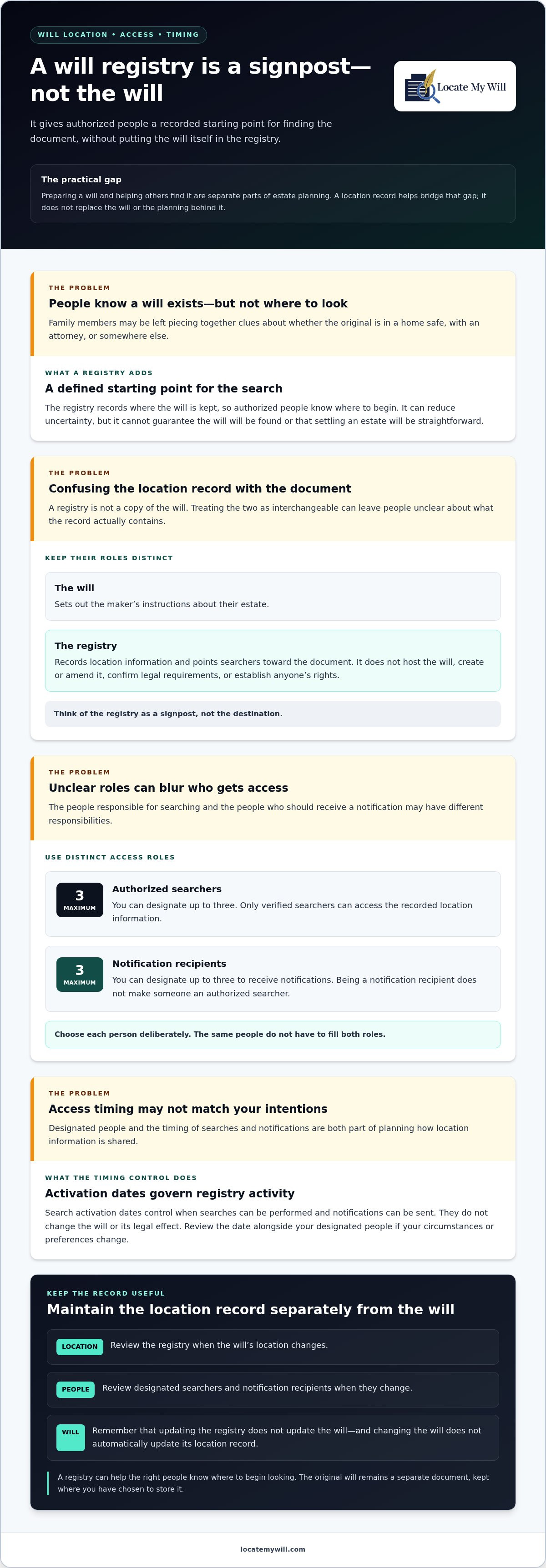
A registry and digital document storage serve different purposes. A registry records where your will is kept; it doesn’t host the document, create a will, or determine anyone’s legal rights. It can also help you share location information selectively. With Locate My Will, you can designate up to three authorized searchers and three notification recipients. Only verified searchers can access the recorded information, and search activation dates control when searches can be performed and notifications sent.
This article explains what a registry can and can’t do, how access and timing controls work, and how to keep your location details current. You’ll also find practical ways to help the people responsible for carrying out your wishes know where to start looking.
Key Takeaways
- The benefits of a will registry start with a practical goal: helping the right people know where to look for your will.
- Compare a registry with digital storage, paper notes, and verbal instructions to choose an approach that fits your plan.
- Use clear roles and deliberate access settings to share location information while respecting your privacy.
- Keep your record useful by reviewing it when your will’s location or the people you’ve designated change.
- Locate My Will can complement an estate plan by recording location details and managing authorized searchers and notification timing.
Benefits of a Will Registry: Why a Will’s Location Matters
Preparing a will and making sure others can find it are separate parts of estate planning. A will sets out a person’s instructions; a location record tells the people searching where to begin. The benefits of a will registry come from addressing that practical gap, not from replacing the document or the planning behind it.
A will registry records where a will is kept so authorized people know where to look. It points to the document, rather than storing a copy of it. That distinction matters: the will contains the maker’s instructions, while the registry helps searchers find the will.
What problem does a will registry address?
Imagine a family member knows a will was prepared but doesn’t know whether the original is in a home safe, with an attorney, or somewhere else. The family may have to piece together clues at a stressful time, especially if the person who prepared the will can no longer explain their filing system. A clear location record gives searchers a defined starting point instead of leaving them to guess.
A location record can reduce uncertainty, but it can’t guarantee that the will will be found or that settling an estate will be straightforward. The location may have changed, the will may have been replaced, or other steps may still be needed. Its value is practical and specific: it helps bridge the gap between making a plan and helping others locate the document that expresses it.
How a will registry differs from having a will
A will and a registry have different jobs. A will communicates the maker’s instructions about their estate. A registry records location information so a searcher knows where to look. It doesn’t draft or amend the will, confirm that it meets legal requirements, or establish anyone’s rights. For general background on the purpose and legal context of wills, see the Will and Testament Wikipedia article.
Keep the two records distinct when reviewing an estate plan. Updating a registry entry doesn’t update the will, and changing a will doesn’t automatically make a separate location record accurate. Each needs its own maintenance. If you’re preparing to record a location online, the guide to registering a will’s location online explains that step in more detail.
Think of the registry as a signpost, not the destination. It helps authorized people identify where to search, while the will remains the document that sets out the maker’s wishes. Keeping this distinction clear helps families understand what information they have and what they still need to find.
How a Will Registry Can Support Privacy and Authorized Access
A will’s location can be useful information, but it isn’t the same as a public copy of the document. A registry records where the will is kept. The aim is to make that location available to the appropriate people without broadly sharing the will’s contents. Clear access roles help put that distinction into practice.
With Locate My Will, only verified searchers can access the recorded location information. You can designate up to three authorized searchers and up to three notification recipients. These roles are separate: searchers can access the record, while notification recipients are designated to receive notifications. Choose each person deliberately so everyone’s responsibilities are clear.
Authorization and activation-date controls help manage who can access a will’s recorded location and when searches and notifications can occur. These controls support managed access, but they don’t change the will or guarantee a particular estate outcome.
Why designate specific people to search?
Naming trusted searchers gives the location record a defined audience instead of making it information for anyone to access. Consider who is likely to take responsibility for finding the document and whether those people will know how to act on the information. You can designate up to three authorized searchers. For more detail on assigning these roles, see the guide to managing authorized will searchers.
Notification recipients have a different role. Designating someone to receive a notification doesn’t make that person an authorized searcher. Keeping the roles separate helps you decide who may access the recorded location and who should receive notifications. The same people don’t have to fill both roles.
How activation timing helps manage disclosure
Search activation dates control when searches can be performed and notifications can be sent. Setting a date is part of planning how access unfolds, not a way to alter the will’s legal effect. The will remains a separate document; the activation date applies to the registry’s search and notification process. You can explore the explanation of will-location privacy and activation dates for more context.
Before choosing an activation date, consider whether it matches when you intend searches and related notifications to be possible. Review the date alongside your designated people, especially if your circumstances or preferences change. This helps keep access aligned with the roles and timing you selected.
To record location details and manage designated access in one place, you can record your will’s location with Locate My Will. The platform records location information, not the will itself, so keep the original document where you’ve chosen to store it.
Will Registry vs. Digital Storage, Paper Notes, and Verbal Instructions
These approaches solve different problems. Digital hosting can preserve a copy of a document, while a registry records where the document is kept. A note or conversation can also point someone toward it, but each depends on how the information is shared and kept current. Comparing their purposes makes the benefits of a will registry easier to assess.
| Option | What it records or stores | Who may access it | How updates are handled |
|---|---|---|---|
| Will-location registry | Where the will is kept, not the will itself | Depends on the registry’s access process. Locate My Will allows verified searchers to access recorded information. | The will owner updates the location record when details change. |
| Digital document hosting | A digital file or scan of the will | Depends on the hosting platform and the access granted to others. | The document owner updates or replaces the stored file, according to the platform’s process. |
| Paper note | A written reminder of the will’s location, or other instructions | People who can find or are given the note | The writer revises the note, then makes sure the updated version replaces or corrects the old one. |
| Verbal instructions | Information shared in conversation, rather than a persistent written record | People who heard and remember the instructions | The person must communicate changes again to keep others informed. |
A location record is not a digital copy of a will
A location entry might identify a safe, a file, or a professional’s office where the original is kept. A scan or uploaded document is different: it is a digital copy of the will’s contents. Don’t assume a registry provides document hosting. Locate My Will records location information; it doesn’t host the will. This comparison of document-location registries and digital hosting explains the distinction further.
Let your priority guide your choice. If you want to help a searcher find the original, a location record addresses that task. If you want an electronic copy, hosting serves a separate purpose and has its own access and update arrangements. One method doesn’t automatically replace the other.
Why informal instructions can become difficult to rely on
A conversation can be a useful way to tell a trusted person where to look, particularly if the location is simple. But someone may forget the details or be unavailable to pass them on. A paper note leaves a written reference, yet it can become outdated if you move the will and don’t revise the note. These methods can still help, but they rely on people remembering, finding, or updating the information.
No single method suits every estate plan, and a registry can’t guarantee discovery. Decide what each option needs to do, then maintain the records that fit your needs. A current location entry can complement the will and other records without confusing a pointer to the document with the document itself.
How to Make a Will Registry Record Useful Over Time
A location record is useful only when it reflects your current arrangements. Keep the will itself and its location information distinct: the will contains your instructions, while the registry helps designated people find the document. The benefits of a will registry depend in part on keeping that pointer clear and current.
Use this checklist to create a practical record:
- Identify the will. Make clear which will the location details refer to, especially if you have replaced or updated an earlier document.
- Record where it is kept. Give your intended searchers clear directions without copying the will’s contents into the location record.
- Select authorized people. Decide who should be able to search and who should receive notifications. Make sure the roles reflect your current choices.
- Review after changes. Revisit the details after moving the document or changing designated searchers or notification recipients.
Update the registry whenever the document’s location changes. If you move the will from one safe location to another, old directions can mislead searchers unless you revise the record.
What information should a location record communicate?
Write directions that make sense to the people you’ve authorized to search. Describe where the will is kept in plain language, rather than relying on shorthand or a phrase only you understand. The goal is to point searchers toward the document, not reproduce its terms or create another version. Keep the will separate and maintain it according to your estate-planning arrangements.
Ask yourself what a trusted searcher would need to understand the location without your explanation. A precise description is more useful than an incomplete clue. A location record can’t resolve every question about a will, but clear directions give searchers a more dependable starting point.
When should you review the record?
Review the entry whenever the will moves, and revisit the people listed if your authorized searchers or notification recipients change. These updates keep the record aligned with your current arrangements. For example, if you move the original document but leave the old location in the registry, the record no longer points to where the will is kept.
You can also make a review part of your routine estate-plan check-in. There’s no need to change accurate details just for the sake of changing them. The purpose is to confirm they still match your decisions. A review can also prompt you to check that the will remains identifiable and in the place your location record describes.
To keep your location details, designated people, and related arrangements organized in one registry, record your will’s location with Locate My Will.
How Locate My Will Fits Into a Practical Estate Plan
Locate My Will lets you record where your will is kept and manage who may search for that location. It complements an estate plan by helping make the document’s whereabouts easier to communicate, while keeping the will itself separate. The platform doesn’t draft or store the will, and a location record doesn’t establish the document’s validity or determine anyone’s legal rights.
Think of the account as a maintained record of location details and the access arrangements you select, not the will’s text. The benefits of a will registry depend on keeping those details aligned with your actual plan. If the original moves, update the recorded location so it continues to point searchers in the right direction.
What users manage through Locate My Will
Through the platform, users record where the will is kept, designate authorized searchers and notification recipients, and manage search activation dates. You can designate up to three authorized searchers and up to three notification recipients. Only verified searchers can access the recorded information. Activation dates control when searches can be performed and notifications sent.
These roles and controls help organize access without making the will itself broadly available. Searchers are authorized to access the location information; notification recipients are designated to receive notifications. Locate My Will is a paid subscription service for recording and managing information about a will’s location.
A location registry as one part of estate preparation
A registry works alongside the will, not in place of it. Maintain the will as a separate document, and use appropriate legal advice for questions about preparing or updating it. The registry addresses a practical administrative task: recording where the document is kept and setting out who may search and when.
For example, if you move the will from a home safe to another location, revise the registry details to match. Review designated searchers, notification recipients, and activation-date settings when your arrangements change. This keeps the location record consistent with your decisions, though it can’t guarantee that someone will find the document or resolve other estate matters.
If a maintained location record would support your estate plan, Set up a clear record of your will’s location with Locate My Will.
Make Your Next Estate-Planning Step Count
Estate planning is easier to maintain when each part has a clear place in your routine. Choose a time to review your arrangements, such as during an annual paperwork check, and revisit them after a meaningful life change. A reminder can help prevent useful information from quietly becoming outdated.
The benefits of a will registry matter most when the record reflects your current decisions. Consider whether your plan gives the right people a clear starting point and whether the location information is up to date. A small administrative step can make your intentions easier to act on later.
Record your will’s location with Locate My Will to take a practical step toward a more organized estate plan.
Frequently Asked Questions
Does a will registry create or validate a will?
No. A registry records where a will is kept; it doesn’t draft, sign, amend, or validate the document. For example, adding a location record after revising your estate plan doesn’t make that revision part of the will. Keep document preparation and location tracking as separate tasks. Questions about whether a will is valid depend on applicable law and should be addressed separately from registry use.
Is a will registry the same as storing a will online?
No. A will registry records a document’s location, while digital hosting means keeping a digital copy online. Locate My Will records location information, not the will itself. If your original is in a home safe, for instance, the registry can point to that location, but it doesn’t provide a scan as a backup. Make plans for the document itself separately.
Can someone search a will registry without being authorized?
Locate My Will allows only verified searchers to access the recorded information. Users designate authorized searchers, and activation-date controls govern when searches can be performed. The registry doesn’t provide access to the will’s contents. When deciding whom to authorize, consider who could reasonably be responsible for locating the document, and keep the access list aligned with your current wishes.
What happens if I move my will after registering its location?
Update the location record to show where the will is now kept. If you move it from a home safe to a different place, searchers relying on the old entry may be directed to the wrong location. Use the move as a prompt to review the directions and confirm that your designated people and notification arrangements are still appropriate.
How many people can be designated to search for a will through Locate My Will?
You can designate up to three authorized searchers through Locate My Will. You can also designate up to three notification recipients, who have a separate role from searchers. For example, you might authorize the person expected to locate the document while choosing different people to receive notifications. Review each designation so the access and notification roles reflect your intentions.
Does registering a will’s location guarantee that family will find it?
No. A registry can’t guarantee that a document will be found or that searchers will act on the information. The benefits of a will registry include giving designated, verified searchers a useful starting point, especially when you keep the record accurate. The will must still exist separately. If its location changes, revise the entry so it doesn’t point people toward an outdated place.
Is a will registry useful if my executor already knows where the will is?
It may still be useful as an organized record, even if your executor already knows the location. Plans can change, and the person who eventually searches may differ from the person you told. A registry gives authorized people a defined way to access location information. It can complement conversations with trusted people, not replace communication about your plans.


