

What if your will is safely stored but no one knows where to look? Learning how to ensure your will is found after death takes more than choosing a place to keep it. The right person also needs a clear, appropriate way to find its location without exposing sensitive details too soon.
It’s reasonable to want both privacy and peace of mind. You may not want to share the exact location widely, but leaving family unsure whom to contact can make a carefully prepared will difficult to find. A practical plan connects the location with authorized searchers and sets expectations about when they can access that information.
This checklist explains how to create that route, keep location details private until access is appropriate, and review your arrangements when your will, storage location, or chosen people change. It also explains how location registration can complement your wider estate-document plan: it records where a will is kept, rather than storing the will itself.
Key Takeaways
- For how to ensure your will is found after death, make a written record identifying the current will and where it is kept.
- Choose storage with protection and practical access in mind, then give an authorized person directions they can follow.
- Review who can search and when access can begin to balance future discoverability with privacy.
- Update your directions whenever you change your will, move it, or need to change the people you’ve designated.
- Locate My Will lets you register location information and manage authorized searchers. It doesn’t store the will itself.
How to ensure your will is found after death starts with a clear location plan
A will’s existence and its discoverability are separate parts of a practical estate plan. You may have prepared and signed a document, but if the people responsible for handling the estate don’t know which version is current or where to start looking, they can face avoidable uncertainty.
A discoverable will is the current document whose location and access path are clearly recorded for an appropriate person to follow. This describes how someone can find the document, not whether it is legally valid. A location record guides a search. It is not the will and cannot establish that the document meets legal requirements.
What does it mean for a will to be found after death?
In practical terms, the process starts when an appropriate person knows that a will may exist and has a contact or directions to follow. They use those directions to identify the likely storage place, locate the document, and determine the next steps under the applicable estate process. Procedures and access rules vary by state, so a location plan should guide the search without being mistaken for legal instructions.
A clear record can identify where the will is kept and who is authorized to access that information. It doesn’t replace the will or prove that a particular version is legally effective. For background on what a will is and its legal context, see Understanding the legal framework of a will.
Why can a will remain undiscovered even when it exists?
The difficulty is often practical. Someone may put a will in a secure place and forget to tell anyone where it is. Instructions may name someone who is no longer available, or point to a cabinet, office, or professional contact that is no longer relevant. If family members don’t know whom to contact, they may not know how to begin a focused search.
Changes can quietly make old directions unreliable. If you move the signed document from a home file to another location, a note naming the old place may send a searcher in the wrong direction. Creating a new will also raises a basic question: which document is current, and where is it kept? Review your record after either change so outdated instructions don’t become the starting point.
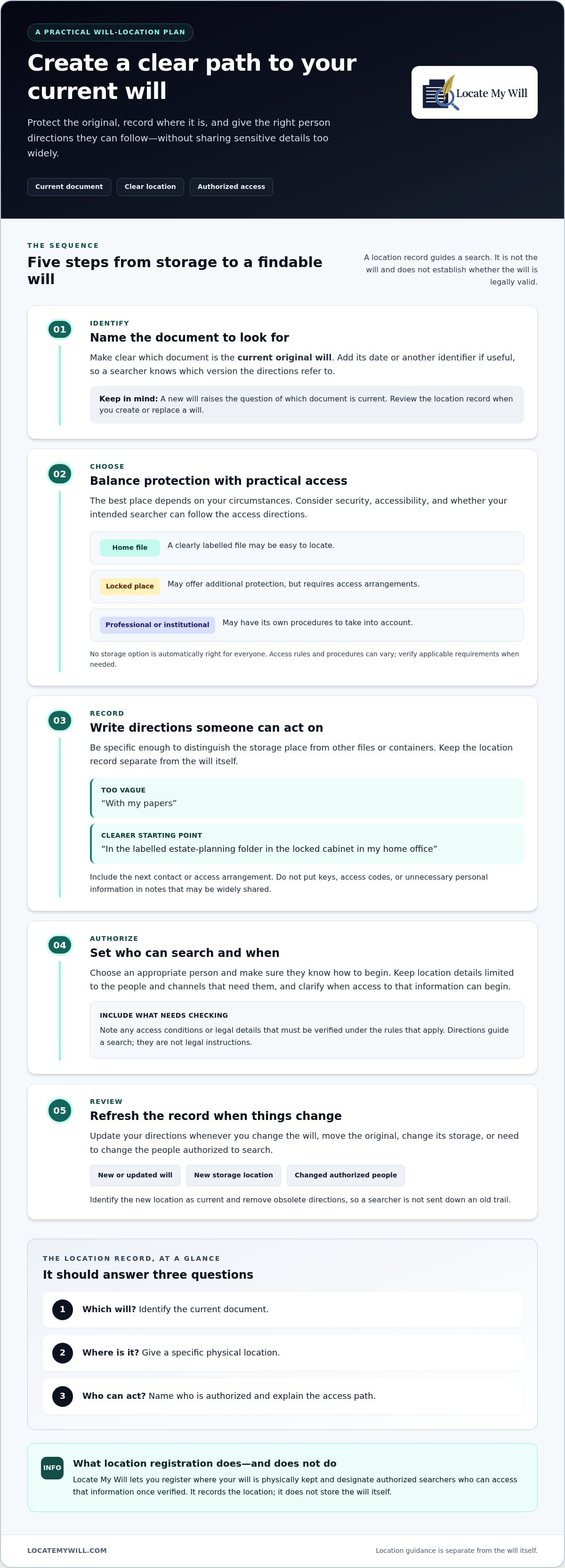
To make how to ensure your will is found after death a manageable planning task, check that your record answers three questions:
- Which will should the searcher look for?
- Where is that document physically kept?
- Who is authorized to use the location information and begin the search?
Keep the answers together and update them when the document, its location, or the people involved change. This won’t determine whether a will is valid, but it gives an authorized person a clearer route to the document and reduces guesswork at a difficult time.
Choose a will storage place and document its location clearly
A suitable storage place needs to protect the original and give an appropriate person a practical way to reach it. Those goals can pull in different directions. A will kept in a locked place may be well protected, but directions that don’t explain how an authorized person can access it may be unhelpful when needed.
Compare the options against your circumstances. A clearly labelled home file may be easy to locate. A locked container may offer additional protection but require access arrangements. A professional or institutional storage arrangement may have its own procedures. No option is automatically right for everyone. Consider accessibility, security, whether your intended searcher can follow the directions, and any applicable rules. If access may depend on a legal process, verify the relevant requirements rather than assuming they are the same everywhere.
A will is a legal document, not simply a note of wishes. Cornell Law School’s Legal Information Institute provides a Legal definition of a last will and testament. Keep the document separate from any record that points to its location. The record guides a search but doesn’t replace the original or establish its legal status.
Make directions specific enough to act on, while limiting sensitive details to the people and channels that need them. “With my papers” leaves a searcher to guess. “In the labelled estate-planning folder in the locked cabinet in my home office” gives a clearer starting point. Don’t put keys, access codes, or unnecessary personal information in notes that may be widely shared.
A trusted searcher’s location record should answer these basic questions:
- Which document? Identify it as the current original will, and note the date or another identifier if useful.
- Where is it? Name the type of storage place and give enough detail to distinguish it from other files or containers.
- What is the next step? Explain whom to contact or what access arrangement applies, without including credentials in a broadly shared note.
- What needs verification? Note any access conditions or legal details that must be checked under the rules that apply.
Keep these directions current. If you move the original or change how it is stored, update the record promptly, identify the new location as current, and remove obsolete directions from your notes. Otherwise, a searcher may follow an old trail first. A focused will location registration guide can help you think through how to record the location clearly.
Locate My Will provides a managed way to record where your will is physically kept. Register location information with Locate My Will and designate authorized searchers who can access it once verified. The platform records the location, not the will itself.
Balance will discoverability with privacy and authorized access
Planning how to ensure your will is found after death doesn’t mean sharing its precise location with everyone in your life. A location record can be separate from the will itself: it points an authorized person toward the physical document without hosting it or making it public. Decide deliberately who can access that information and when.
There’s a useful distinction between letting someone know a will exists and giving them its location. An executor or another trusted person may need a clear route to the document, while other relatives may only need to know whom to contact. Consider who is likely to take the next step, and limit access to people you trust to handle sensitive information appropriately.
Who should know where the will is kept?
Start with the person you expect to take the lead in locating the will. Consider whether a backup searcher would help if that person is unavailable, and whether anyone should receive a notification without seeing the location details. Choose people intentionally and explain their roles so they know what to do if access becomes available. Sharing the precise location broadly may expose more information than necessary.
Different approaches offer different balances of convenience and control:
| Approach | Practical advantage | Privacy consideration |
|---|---|---|
| Informal broad sharing | Several people may know where to begin. | More people receive sensitive details than may need them. |
| Private note | The location can be written down and kept discreetly. | A note may be overlooked, become outdated, or be inaccessible to the intended searcher. |
| Controlled search authorization | Access can be limited to selected searchers and tied to an activation date. | Settings and designated people still need review; controls don’t guarantee that every circumstance is covered. |
How can access timing preserve privacy?
An activation date can help manage when searches may be performed and notifications sent. It lets you plan for future discoverability without making location information available before your chosen settings allow it. Timing controls shape access; they don’t prove a will’s validity or guarantee that someone will locate or act on it.
Locate My Will lets users designate up to three authorized searchers and up to three notification recipients. Only verified searchers can access the recorded location information, and searches and notifications are governed by the activation settings. The platform records where the will is physically kept; it doesn’t host a digital will or store the paper document.
To record the location and manage authorized searchers, use Locate My Will’s location and access controls. Review your designated people and timing as circumstances change, so your privacy choices remain deliberate and intended searchers have a defined path.
Keep your will-finding plan accurate as life and documents change
A location plan is useful only while it reflects your current arrangements. Treat it as a living record, not a one-time task. A new will, a move, or a change in whom you trust to help can leave earlier directions pointing to the wrong document, place, or person. A short review after a change keeps your records aligned.
When should you review will location information?
Review your plan whenever you replace or update your will, move the original, or change its storage arrangement. Reassess your designated people if their availability, relationship to you, or responsibilities shift. These are practical prompts, not a legal review interval. If you set a regular reminder, treat it as a personal routine, not a rule that determines the will’s validity.
What should the review checklist include?
Use this routine whenever a change occurs. Work through each check so your record reflects the document you intend people to locate and the current access arrangements.
- Confirm the document. Identify which will is current, then check that your location record refers to it. If you’ve made a new will, don’t assume earlier directions still identify the right version.
- Confirm the location. Compare the recorded details with where the original is now kept. If you’ve moved it or changed its storage arrangement, revise the directions promptly and remove obsolete copies or notes that could send someone to the wrong place.
- Review the designated people. Check that your authorized searchers and notification recipients are still the people you intend. Update the record if someone’s role, contact details, or ability to act has changed.
- Check the timing settings. Confirm that activation settings still reflect when you intend searches and notifications to become available. Adjust them if your privacy preferences or plans have changed.
Keep the review focused on consistency. After moving, verify both that the will is in its new storage place and that the location record reflects the move. Updating only one can leave a gap between the document and the directions. After making a new will, review related notes and records too, so older references don’t appear to compete with your current instructions.
These small checks turn how to ensure your will is found after death into an ongoing maintenance habit rather than a search problem left for others. The consequences of a lost will offer further context on why accurate directions matter. The routine remains the same: review the document, location, people, and timing after relevant changes.
Keep your location record and access details aligned as your plans evolve. Update your will location and authorized searchers with Locate My Will to maintain a record of where the will is physically kept.
Create a clear path for someone to find your will
A practical plan comes down to three connected decisions: identify the will you consider current, record where the physical document is kept, and decide who may search for its location information. Keeping these details aligned gives the person handling the next steps a clear starting point, while the will remains in the storage arrangement you’ve chosen.
This is the working answer to how to ensure your will is found after death: make the location known through a deliberate, maintained process instead of relying on memory or scattered instructions. A registry can support that process, but it doesn’t make a will legally valid or guarantee that it will be found or enforced.
How does a will location registry fit into the plan?
Locate My Will is a paid platform for recording where you keep your will and managing authorized access to that information. It does not draft a will, host a digital will, or physically store the document. Designated searchers, notification recipients, and activation dates provide a structured way to manage who may access location details and when searches or notifications can occur, according to the settings in place.
Users can designate up to three authorized searchers and up to three notification recipients. Only verified searchers can access the recorded location information, and activation settings control when searches and notifications can occur. These features support a planned route to the document. They don’t replace keeping the physical will accessible under your chosen arrangements or reviewing your instructions when circumstances change.
Once someone is authorized to search, they may still need a clear process for what to do next. An executor’s guide to finding the will can help explain the practical search steps after a death. Keep those steps distinct from your location record, which points to where the document is kept.
What should you do next to make your will easier to find?
Gather the details you’ll need before setting up or updating your record. Confirm which will is current and where the original is physically kept. Then decide whom to authorize as a searcher and whether anyone should receive a notification. Choose activation timing carefully, based on when you intend searches and notifications to become available. These are planning choices, not legal advice.
After recording the information, review it whenever your will, storage arrangements, designated people, or preferences change. A location record is useful when it remains accurate and the right person can follow its path. It can form one part of a broader estate-document plan, alongside your will and other relevant records.
If you’re ready to put that route in place, create a Locate My Will account and record your will’s location. This gives you a way to document where your will is kept and manage who may access that information.
Make your plans easier to act on
Knowing how to ensure your will is found after death means making a thoughtful decision useful to the people who may need to act on it. Turn what you know into clear directions, then revisit them whenever your circumstances change. Your preparation can keep pace with your life instead of relying on someone else to reconstruct it later.
You don’t need to solve every part of estate planning at once. Begin with the location information you already have, decide who should be able to use it, and choose an arrangement that balances future access with present privacy. A clear record gives those entrusted with your affairs a practical starting point.
Record your will’s location with Locate My Will and put a clear path in place for the people who may need it. Careful preparation today can make a difficult moment more orderly for those you care about.
Frequently Asked Questions
Can a will be found online after someone dies?
Sometimes, but an online search won’t automatically reveal a will. A location registry may help an authorized person identify where a physical document is kept if its owner recorded that information and the search meets the registry’s access settings. That’s different from searching for or downloading the will itself. If you’re helping someone, check known location records and follow the applicable local process rather than assuming the document is stored online.
Is telling the executor where the will is kept enough?
It’s a useful step, but it may not cover every practical situation. The executor might be unavailable, forget the details, or need to know whom to contact before reaching the document. Give clear directions and explain how they can access them. If you keep a separate record, make sure it stays current and that the executor knows it exists. Avoid relying only on a conversation that no one else can verify or recall.
Should I keep my will in a safe-deposit box?
It depends on how the box can be accessed and the rules that apply where you live. Don’t assume a relative or executor will be able to open it immediately after a death. Before choosing this arrangement, find out what access steps may apply and whether they could delay retrieval. The original will may be needed for later estate procedures, so consider whether your intended searcher has a workable route to it.
Can I register where my will is kept without uploading the will?
Yes. Locate My Will records information about where you physically keep your will; it doesn’t require uploading the document. The location record and the will serve different purposes: one points an authorized searcher toward the document, while the other contains the will itself. This distinction can help when planning how to ensure your will is found after death while keeping the document in your chosen physical storage arrangement.
What happens if I move my will after recording its location?
Update the location record as soon as you move the original or change its storage arrangement. For example, if the record points to a home office but you’ve moved the will elsewhere, a searcher could waste time following outdated directions. Check related notes too, and remove or mark old instructions as obsolete so they don’t conflict with the current record.
How many people should know where my will is?
There’s no single number that suits everyone. Choose enough trusted people to provide a clear route to the document without sharing precise location details indiscriminately. You might tell someone the will exists while reserving the location information for an authorized searcher. Locate My Will allows up to three authorized searchers and up to three notification recipients, so consider who genuinely needs each role.
Does a will location registry make my will legally valid?
No. Registering a location records where a will is kept; it doesn’t create the will or establish that it meets legal requirements. Validity depends on applicable rules and the document’s circumstances, which can vary by jurisdiction. Keep the original document and related records in order, and treat location registration as an administrative aid, not a substitute for satisfying the legal requirements that apply to your will.


