

The original will may be closer than you think, but finding a document isn’t the same as confirming it’s the one the probate court needs. Locating original will for probate is a document-control process: search methodically, record what you find, and preserve the document for the next steps.
If your family isn’t sure whether a will exists, or has found only a copy or draft, it’s understandable to feel uncertain about where to begin. An organized search can help you check likely places and identify people who may know where the signed original was kept. This guide explains how to handle a document you find and what to consider if you don’t find one.
Probate procedures depend on state rules, so a process described online may not apply where the estate is handled. For future preparedness, recording a will’s location separately can help verified, authorized searchers access that information when a search is activated. The platform records the location, not the will itself.
Key Takeaways
- Use a step-by-step search and keep a record of the places checked, people contacted, and findings.
- When locating original will for probate, compare signatures, dates, markings, and attachments, but treat these as observations rather than proof of legal validity.
- Preserve the document carefully and identify the probate requirements that apply in the relevant state.
- A copy or draft may offer useful clues, but the court’s process for addressing an absent original can vary.
- For future preparedness, record where the physical will is kept and designate verified authorized searchers who can access that location information.
Why locating the original will matters for probate
When a family begins locating original will for probate, the goal isn’t simply to find any document that describes the deceased person’s wishes. The original is generally the executed document: the version signed by the person making the will, known as the testator, and intended to express their final wishes. Finding it gives the family and the court a specific document to assess during the estate process.
Probate is a court-supervised process for dealing with a person’s estate after death. The Probate process provides a general overview. Requirements for submitting a will, or explaining that an original can’t be found, depend on the state and the circumstances. Some procedures may require additional evidence or steps when only a copy is available. Don’t assume a copy will be accepted or rejected everywhere.
The original’s location can shape the probate process before anyone files paperwork, because it helps determine which document can be presented and what questions may need to be resolved. Locating a will and establishing which version governs are separate tasks. A signature or date is useful to record, but visible details alone don’t determine legal validity or establish whether a later document changed the testator’s wishes.
Original, copy, and draft: what is the difference?
An original is the executed document, while a photocopy or scan reproduces its contents. A draft may contain proposed wording, edits, or notes, and an unsigned version may not show that the testator adopted it as final. These distinctions help families describe what they found without making a legal conclusion. If there are multiple versions, keep them separate and note where each was found. The applicable state’s rules determine how the court may treat them.
Why a probate search needs a careful starting point
Begin with the decedent’s most recent known home and organized personal records. Look for estate-planning folders, correspondence, or other records that could point to where a signed will was kept. Treat a folder label or handwritten note as a lead to follow, not confirmation that the will is there.
Relatives and close contacts may know who helped prepare the will, whether it was placed in a safe-deposit box, or who was named as executor. Their knowledge can point to the next place to search, even if they don’t have the document. Ask focused questions and record whom you contacted, when, and what they said. If no one knows where the will is, use these leads to guide a broader search. The same organized approach supports a general guide to How to Find a Deceased Person’s Will, while this probate-focused search keeps the original document at the center.
How to search for the original will: an organized sequence
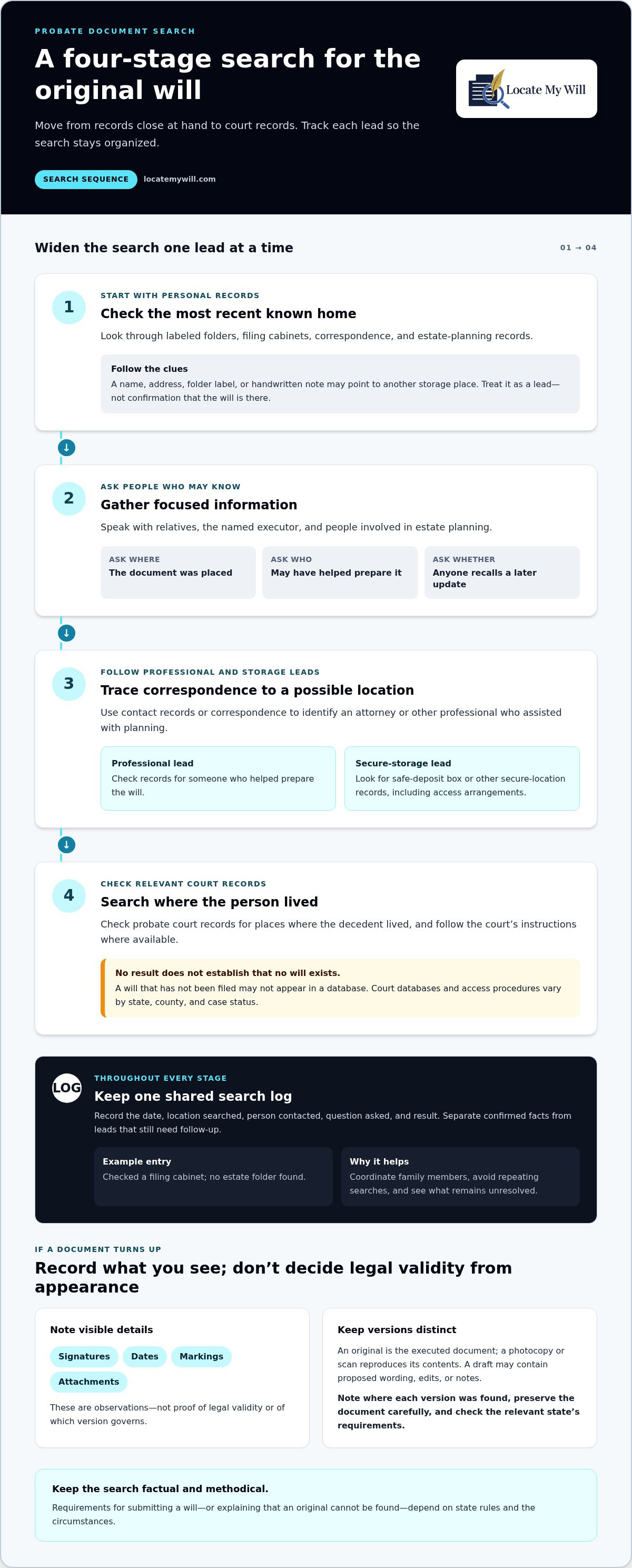
A structured search helps the family cover likely leads without duplicating effort. Start with personal records, then ask people who may know, follow professional or financial-storage clues, and finish by checking relevant court records. This sequence moves from information close at hand to searches that may depend on court access or an existing case.
- Review personal records. Check the decedent’s most recent known home, labeled folders, filing cabinets, correspondence, and estate-planning records. Note names or addresses that point to another storage location instead of assuming the will itself is in the file.
- Ask close contacts. Speak with relatives, the named executor, and people involved in the estate-planning process. Ask where the document was placed, who may have helped prepare it, and whether anyone remembers a later update.
- Follow professional and financial-storage leads. Use correspondence or contact records to identify an attorney or other professional who assisted with planning. Look for records of a safe-deposit box or another secure location, and note any access arrangements that may affect the search.
- Check relevant court records. Search probate court records for places where the decedent lived, following the court’s instructions where available. A will that hasn’t been filed may not appear in a database, so no search result doesn’t establish that no will exists.
Keep a search log as you go
Record the date, location searched, person contacted, question asked, and result. For example, note that you checked a filing cabinet on a particular date and found no estate folder. Separate confirmed facts from leads that still need follow-up. A shared log helps family members coordinate, avoid repeating searches, and see what remains unresolved.
Adapt the court search to the case
Court databases and access procedures vary by state, county, and case status. Some records may be searchable online; others may require a request to the relevant court. Before relying on a result, note which court you searched and how. For general context on legal terminology, Cornell Law School’s Legal Information Institute explains a Legal Definition of a Will, but state rules determine how a document is treated in a particular probate matter.
This sequence gives an executor a clear record of the search and a practical basis for choosing which lead to pursue next. For a fuller executor-focused search protocol, document each handoff and follow-up. For future preparedness, record where a will is kept so verified, authorized searchers can access that location information when searches are activated. The service records the location, not the physical will.
How to tell whether the document you found is the original
Finding a document is an important step, but its appearance alone may not establish whether it is the signed original or the version that governs. During locating original will for probate, compare visible details and record what you observe without making legal conclusions. If there are several versions, keep them distinct and let the relevant probate process determine how they should be assessed.
Use the following comparison as a recordkeeping aid, not a validity test. Note what you can see, including anything unusual, without writing on or otherwise changing the document.
| Feature | What to observe and record |
|---|---|
| Signatures | Note whether signatures appear on the document and where. Don’t treat a visible signature as proof that the document meets applicable legal requirements. |
| Markings | Record handwritten notes, crossed-out text, staple marks, or other visible changes. Describe them neutrally rather than deciding what they mean. |
| Dates | Write down the date shown on the document and any dates on related papers. A later date may be a lead to investigate, not a conclusion about which version controls. |
| Attachments | Note attached pages, referenced schedules, or papers that appear to accompany the will. Keep them together as found. |
| Copy indicators | Observe whether the item appears to be a photocopy, scan, or printout. A copy’s legal treatment depends on the applicable state rules and case circumstances. |
Compare dates, signatures, and related papers
Read the document carefully, but don’t add notes, labels, or marks to it. Record dates and visible signatures separately. Look for attached pages, references to codicils (documents that may amend a will), or mentions of another version. If two documents differ, describe the difference, such as “one page has a handwritten note,” without deciding which one reflects final intent.
Preserve the document and its search history
Keep the document in the condition in which you found it. Don’t separate pages that appear attached or rearrange materials in a way that could obscure how they were stored. Record the discovery date and location, who found the document, and who handled it afterward. This creates a clear account of its path through the family.
A photograph or scan can help with recordkeeping and let the family refer to the visible contents, but it doesn’t replace the physical original. Store any digital record securely and keep it distinct from the document itself. If the original remains missing after a careful search, the next questions may concern the state’s process for a lost will. Don’t assume that a copy settles the matter.
What to do with the original before probate filing
After locating original will for probate, protect the document while identifying the process that applies to the estate. Filing deadlines, submission requirements, and procedures can depend on the state and the circumstances. Consult official court information for the relevant jurisdiction to understand what the person responsible for estate administration needs to do before submitting the original.
Probate filing requirements are jurisdiction-specific and should not be generalized. For example, the research provided for this guide notes that Florida requires a person holding a will to file it with the probate court within 10 days of learning of the death, while Tennessee sets a 30-day period. These are state-specific examples, not a nationwide deadline. Other filing duties and procedures may differ, so don’t rely on a deadline described for another state.
Practical document handling is separate from legal advice. A family can keep the will and related papers together, record where the document was found, and prepare a clear handoff. Those steps don’t determine whether the will is legally valid, which version controls, who inherits, or how the estate should be administered. Those questions depend on applicable law and the case.
Prepare a clear handoff without changing the document
Keep the original and any attachments together in their found condition until the applicable submission process is clear. Don’t write on, remove staples from, or rearrange the document. Give the person responsible for estate administration the search log and discovery notes, including where and when the will was found and who has handled it. Share sensitive personal details only with people involved in the process.
A practical handoff record can include:
- The document’s discovery date and location.
- The names of people who have handled or transferred it.
- Any related pages or papers found with it.
- Questions still needing an answer about filing or submission.
This record helps the responsible person understand the document’s history without altering the will itself. Keep copies of your notes separate from the original, and store them with appropriate care.
Understand court records and state-by-state differences
A will may not appear in public court records before it has been filed. Even after a case begins, access to records and the way to request them can depend on state rules, the court, and the case’s status. An empty online search doesn’t establish that a will doesn’t exist, and a record found online may not explain how the original should be submitted.
Check the relevant court’s official instructions for current filing steps, required documents, and record-access procedures. Confirm which court handles the estate and whether a case has already been opened. Treat online summaries as general orientation, not a substitute for the rules that apply to the specific matter.
For future preparedness, record where your own physical will is kept and designate authorized searchers. Record your will’s location so verified, authorized searchers can access that information when searches are activated. The platform records location information; it doesn’t store the will itself.
Prevent the next probate search with a recorded will location
Once the current search is underway, consider how family members would know where to begin in the future. A physical will can remain securely stored, but its location should also be findable by the right people. Recording that location is a separate preparedness step. It doesn’t replace the current search, determine which version governs, or satisfy probate filing requirements.
Locate My Will lets users record where a physical will is kept. The platform stores location information, not the will itself: it doesn’t host or physically store the document. The will remains where its owner keeps it, while the record can help verified, authorized searchers identify that location when a search is activated.
Record the location and manage authorized access
Users can designate up to three authorized searchers and up to three notification recipients. Only verified searchers can access the recorded location information through the platform’s verification process. These roles support orderly access without making the location record a substitute for the original document or extending access beyond authorized, verified searchers.
Think of the record as a practical pointer: it identifies where the physical document is kept, such as with the owner’s estate-planning papers or in another chosen location. If the will is moved, update the recorded location so the information remains useful. The platform does not find an existing will for a family or file it with a probate court.
Use activation dates to manage when searches can occur
Subscription activation dates control when searches can be performed and notifications sent. Setting these dates is part of planning how and when the recorded information may become accessible. Authorized searchers must still be verified, and access is to the location information, not the will itself. This keeps location details distinct from document storage and probate administration.
For someone currently locating original will for probate, a location record won’t resolve the present search or replace state-specific court steps. It can, however, address a separate future question: how will the people responsible know where the physical original was kept? Pair the record with a secure physical storage choice and keep the location information current if that choice changes.
If you’re planning ahead, explore recording your will’s location and designating authorized searchers. It’s a preparedness measure that makes location information findable by verified people at the appropriate time, not a probate search service or a place to store the will.
Make the next step easier for the people you trust
Finding a will can bring clarity, but preparedness also means considering what happens when the document’s owner can no longer explain where it is. A simple, current record of its location can give trusted people a clear starting point while the physical will remains in the owner’s chosen secure place. It’s a practical step that complements estate planning, not a replacement for the document or the probate process.
If you’re locating original will for probate now, focus first on the search and the requirements that apply to the estate. For the future, consider how the people who may need to act will find the location information and when it should become available. Locate My Will lets you record the location, manage authorized access, and set activation timing for searches and notifications.
Record your will’s location with Locate My Will as a separate preparedness step. A current location record gives the people you trust a clear place to begin when the time comes.
Frequently Asked Questions
Can you search probate records for a will before a case is opened?
Sometimes, but a search may not find a will that hasn’t been filed or registered. Court databases often focus on case records, so before a probate case exists, there may be no docket to search. Check court records for places the person lived and look for any separate will-registration process in those jurisdictions. A blank search result doesn’t confirm that no will exists.
Is a will public record before probate begins?
Usually, a will kept privately by its owner isn’t part of a court’s public case file before it is filed. Rules and any will-registration options vary by state, so the document’s status may depend on where and how it was kept. Also distinguish a record that identifies a will’s location from the will itself. Don’t assume that a court can provide a copy before a case begins.
Can someone who is not named executor look for the original will?
Yes. A relative or trusted person can help look for the document even if they aren’t named as executor. The executor’s role in administering an estate is separate from helping identify where paperwork may be kept. Still, respect property access and privacy: ask the person with authority over a home, locked cabinet, or other private space before searching, and avoid removing or distributing documents unnecessarily.
What if the person who died recently moved to another state?
Include both the recent and prior residence in your search. Check personal records and contacts in each place, and identify which probate court may handle the estate based on the person’s circumstances. If the person owned property in another state, that may raise additional estate questions. Keep a record of locations and contacts, then use the relevant courts’ guidance rather than assuming one state’s process applies everywhere.
Can an executor access a safe-deposit box to retrieve a will?
Access depends on state law, the box agreement, and the person’s authority. Being named executor in a will may not be the same as being appointed by a court. For example, Florida law, effective July 1, 2026, requires a personal representative to be allowed access upon presenting letters of administration, unless the lease states otherwise. Check the rules and access process that apply to the specific box.
Does finding the original will automatically start probate?
No. Finding the document doesn’t itself open a probate case. A person responsible for the estate generally needs to follow the applicable court process, which may involve submitting a petition or other paperwork. The steps and any deadline can vary by state and situation, so treat discovery as a prompt to identify the correct process, not as proof that a court case has already begun.


