

What if the safest way to help someone find your will isn’t to put the document online? A secure document location registry records where your will is kept, while digital hosting stores a copy of the document itself. Knowing what each option holds, and who can access it, matters when estate information is sensitive.
This article explains the difference between a location record and digital hosting, and what to consider when making your will easier to find. You’ll learn how access permissions, verification, and notification timing work in practice. Locate My Will is a paid registry service: it records the will’s location rather than hosting the document. You can designate up to three authorized searchers and three notification recipients, with activation dates controlling when searches can take place and notifications can be sent. The goal is to help the right people locate your will while keeping access managed.
Key Takeaways
- A will location record helps point authorized people to the document without sharing its text.
- Someone permitted to search for location details and someone who receives a notification have different roles.
- When evaluating a secure document location registry, consider how access is verified, when searches can begin, and how location details stay current.
- Digital hosting keeps a file online; a location registry and document hosting serve different purposes.
- Use the comparison and checklist in this article to decide how to make your will easier for the right people to locate.
What Does a Secure Document Location Registry Actually Record?
A secure document location registry records where a will is kept, not the will’s text. It creates a reference to help an authorized person know where to look when the document is needed. The location might be a home safe, a filing cabinet, or a professional’s office. The record points to the document; it doesn’t replace it.
Knowing that a will exists isn’t enough if family members or an executor can’t find it. A clear, up-to-date location record can reduce guesswork by directing the appropriate people to the document. For that record to be useful, its details need to be accurate and access needs to follow the owner’s instructions.
How Is a Will Location Record Different From the Will?
The will contains the person’s estate-planning instructions and legal wording. A location record says where that document can be found. For example, it might point to a labelled folder in a home safe without including any of the will’s clauses or personal instructions.
Keeping these functions separate can limit the sensitive information shared through a registry. The will owner is responsible for keeping the original accessible and updating the location record if the document moves. A registry doesn’t draft the will, store the physical original, or determine whether the will is legally valid.
Why Can the Search Results Mean Two Different Things?
“Document location registry” can mean different things depending on the context. Some search results, including Microsoft guidance and computer-support discussions on sites such as DiskPart and Super User, use “registry” to mean Windows settings related to folders such as Documents or Downloads. Those settings concern computer file paths, not where a person’s will is kept.
This article focuses on estate planning. A secure document location registry records the whereabouts of a will for authorized access; it isn’t a Windows setting or a way to change a computer folder. Digital file systems serve a different purpose. A Document Management System (DMS), for example, relates to organizing and managing electronic files, rather than simply recording where a physical will is kept.
It’s also useful to distinguish a location record from digital hosting. Hosting involves keeping a digital file online. A location registry records where the will is kept and doesn’t provide a digital copy. The two approaches answer different practical questions: “Where can the will be found?” and “Where is the digital file stored?”
Locate My Will is designed for the first purpose. It records a will’s location without hosting the will itself. The owner enters location details and can designate authorized searchers. Only verified searchers can access that information. Keep the physical document somewhere you can describe accurately, and update the record if its location changes. A location record supports access planning, but responsibility for the will itself remains with its owner.
How Does a Will Location Registry Help the Right People Find a Will?
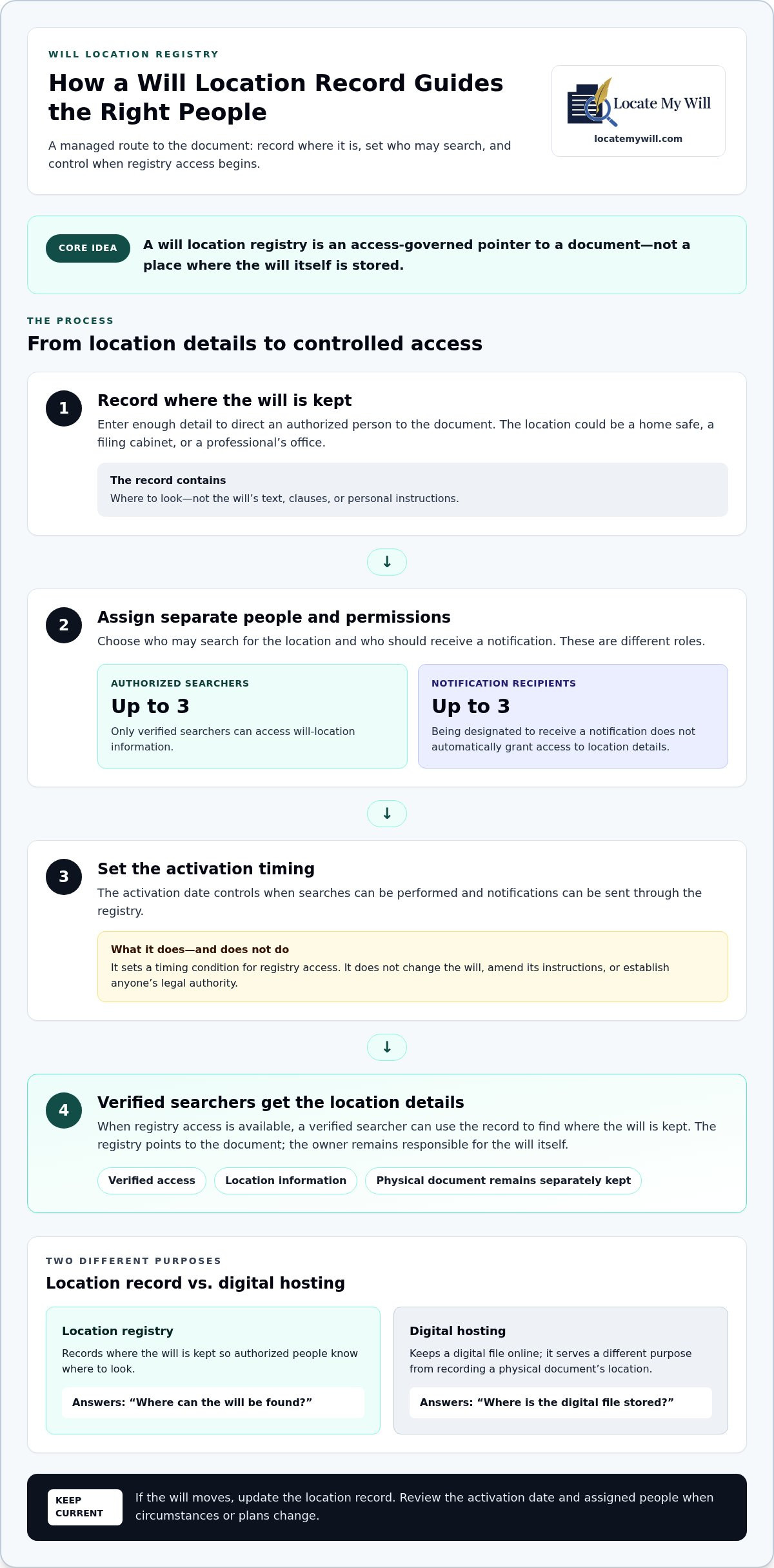
A registry turns finding a will into a planned process rather than a guessing exercise. The owner records where the will is kept, identifies who may search for that information, and sets conditions for when access and notifications can begin. Each step has a distinct purpose: the location record provides direction, authorization controls who may view it, and timing determines when access becomes available.
Put simply, a will location registry is an access-governed pointer to a document, not a place where the document is stored. It is useful only if the people and timing are selected deliberately and the location details stay current.
- Record the location. Include enough detail to help an authorized person understand where the will is kept.
- Designate the people. Decide who may search for location information and who should receive a notification.
- Set access conditions. Choose activation timing that reflects your wishes, then review the settings if your circumstances change.
These controls help make the route to the will clear without making the document itself broadly available. For general guidance on organizing and protecting sensitive files, Ricoh’s Best Practices for Secure Document Management offers useful context. A location registry has a narrower role: managing access to information about where a will is kept.
What Roles Do Searchers and Notification Recipients Have?
An authorized searcher is someone permitted to access will-location information after verification. A notification recipient has a separate role: they are designated to receive a notification, but that designation doesn’t automatically grant access to location details. Keep these roles distinct when deciding who can find the record and who should be informed. Assign each person the role that matches your intentions.
Locate My Will lets users designate up to three authorized searchers and up to three notification recipients. Only verified searchers can access location information. These separate permissions let the owner manage search access and notifications without treating them as interchangeable.
What Does an Activation Date Control?
An activation date determines when searches can be performed and notifications sent through the registry. It doesn’t change the will, amend its instructions, or establish anyone’s legal authority. Instead, it sets a timing condition for registry access. Choose a date that matches your wishes and revisit it periodically to make sure the setting still reflects your plans.
Reviewing the date is particularly useful after a change in circumstances, such as replacing a will or changing who you want involved in finding it. Locate My Will combines verified searcher access with activation-date controls, giving owners a defined way to manage when location information can be accessed. If you’re planning who should be able to locate your will and when, explore will location registration as one practical way to record those choices.
Secure Location Registry vs. Digital Hosting: What Is the Difference?
A location registry and digital hosting address different needs. A registry records where a will is kept and manages who may access that location information. Digital hosting stores a digital file. One helps an authorized person find the document; the other keeps an electronic copy available within an online service.
A location registry points to a document; hosting retains a digital copy. Neither tells you where the physical original is kept. Physical storage is a separate decision: choose an appropriate place for the original, then make sure the location record reflects it.
| Method | Purpose | Information held | What the method does not do |
|---|---|---|---|
| Will location registry | Directs authorized people to where a will is kept. | Location details and, depending on the service, access or notification settings. | Does not store the will’s text or provide its contents for reading online. |
| Digital hosting | Keeps a digital file in an online service. | A digital copy of the document. | Does not, by itself, establish where the physical original is kept. |
| Physical storage | Keeps the original document in a chosen physical place. | The paper will itself. | Does not automatically create an online record that tells others where to find it. |
What Does a Location Registry Do That Digital Hosting Does Not?
A location registry records a will’s whereabouts and can manage access to that information. It doesn’t provide the will’s contents for someone to read online. Digital hosting serves a different function by retaining a digital file, but that file alone may not tell someone where the physical original is kept. The approaches aren’t interchangeable in every estate plan. The right arrangement depends on what information needs to be accessible and how.
When Might Someone Use Both Approaches?
Someone might keep the original in a chosen physical location, maintain a registry record pointing to it, and separately keep a digital copy. These arrangements serve different purposes, and a digital copy shouldn’t automatically be assumed to have the same legal standing or use as an original. Requirements depend on the circumstances and jurisdiction. For questions about a will’s validity, signing, or execution, seek guidance from a qualified legal professional.
A secure document location registry is useful when the priority is to record where a will can be found while controlling who can see that information. Locate My Will follows this location-record approach: it records where the will is kept without hosting the document itself. This distinction sets clear expectations. A registry can point authorized searchers toward the will, but the owner remains responsible for maintaining the document and keeping its recorded location accurate.
How to Evaluate a Secure Document Location Registry
Evaluate a registry by how clearly it explains what it records, who can access that information, and when access can begin. The word “secure” alone doesn’t tell you which safeguards a service uses. Start with the access rules and settings that affect your location record, and make sure you understand how they work before relying on the service.
Use this checklist to assess whether the arrangement fits your wishes:
- Information recorded: Identify exactly what location details the registry holds, and whether it stores the document or only its location.
- Searcher verification: Understand whether access is restricted to designated searchers and how their identities are verified.
- Separate roles: Check how search permissions differ from notification permissions, so you know who can see location information and who may receive a notification.
- Activation timing: Review what the activation date controls, including when searches can be performed and notifications sent.
- Record maintenance: Find out how to update location details and manage designated people if your circumstances change.
Which Access and Privacy Controls Should You Understand?
Look for a clear distinction between someone authorized to search and someone designated to receive a notification. A notification role shouldn’t be assumed to grant access to location information. Understand what verification means in the registry’s process and what a verified searcher can access. Read the activation settings carefully: they govern search and notification timing, not the will’s contents or anyone’s legal authority.
Locate My Will verifies searchers before they can access will-location information. Users can designate up to three authorized searchers and three notification recipients, while activation dates control when searches and notifications can occur. These controls define how access is managed. They don’t mean the platform stores the will or verifies its legal validity.
How Should You Keep a Location Record Useful Over Time?
A record can become inaccurate if the will moves and its location isn’t updated. Review it after changing storage arrangements, moving, or revising your estate plans. Keep designated people’s roles and contact details current as well. A periodic review can catch outdated information before someone needs to rely on it.
For broader preparation, consider the guidance in “How to Make Your Will Easy to Find for Your Executor.” The related guide “Register Will Location Online: Estate Security Guide” can also help you think through recording a location online. Use both as prompts to check that your location details, search permissions, notification choices, and timing still reflect your intentions.
Locate My Will provides a managed way to register a will’s location, with verified searcher access and activation-date controls. Set up your will location record to document where your will is kept and define who may access its location information.
How Locate My Will Records a Will’s Location Without Hosting It
Locate My Will records where a will is kept; it doesn’t host the will itself. The platform is for documenting the will’s location and managing who may access those details. The will owner remains responsible for the document and its physical storage. An online registry can therefore record a location without uploading the will’s text as a digital copy.
To set up a record, enter the location details and choose who may search for them. Be specific enough to help an authorized person understand where to look, and update the record if the will moves. You can designate up to three authorized searchers and up to three notification recipients. These are separate roles: a notification recipient isn’t automatically given access to the location information.
What Happens When Someone Is Designated to Search?
A designated searcher must be verified before accessing the recorded location information. This is managed access, not public access or unrestricted sharing of the will. Verification applies to access to location details; it doesn’t confirm the will’s legal validity. Registration also doesn’t guarantee that a searcher will find or retrieve the document. The record provides direction, while the will remains wherever its owner has stored it.
What Does the Locate My Will Subscription Provide?
The paid subscription provides a way to register where a will is kept and manage authorized searchers. The owner can also designate notification recipients and set activation dates. Those dates control when searches can be performed and notifications sent. They don’t change the will or determine anyone’s legal authority. Review the roles and timing you select so they continue to reflect your preferences.
In practical terms, a secure document location registry helps people find a will without placing its contents online. Locate My Will doesn’t draft wills, store physical documents, or host digital wills. Its purpose is to maintain the location record and manage access to that information through verified searchers and activation-date controls.
Before creating a record, consider whether you know where the will is kept, whether your location details will guide someone clearly, and who you want involved in a search or notification. Then decide whether Locate My Will’s location-recording and access-management approach fits your plans. If it does, set up a subscription and record the location according to your preferences.
Make Your Will Easier to Find When It Matters
Estate planning isn’t only about setting out decisions. It also means considering how the people responsible for carrying them out will know where to begin. Review your current arrangements: does the way you’ve recorded your will’s location match how you want information handled, and will the record stay clear if circumstances change?
A secure document location registry can be part of a broader plan for making important documents findable. Keep the location record distinct from the document itself, choose an approach that fits your preferences for access and privacy, and review the arrangement as part of your estate-plan check-ins. Thoughtful organization can reduce uncertainty for the people you intend to support later.
Start by confirming where the original is kept, whether your location description is clear, and who should be able to search for it. Then review those arrangements whenever the document or your plans change.
Ready to record your will’s location? Explore Locate My Will and record your will’s location.
Frequently Asked Questions
Does registering a will’s location change the will’s legal validity?
No. A secure document location registry records where a will is kept; it doesn’t draft, amend, or validate the document. For example, adding a new location record won’t change the wording of a will or confirm that it was properly signed. Whether a will was properly made or remains legally effective depends on the circumstances and applicable law. Consult a qualified estate-planning attorney for advice about a specific document.
Should I still tell my executor that I have a will location record?
Yes. Let the appropriate people know a location record exists and explain their role, so they understand where to begin if they need to locate the will. A registry can organize access, but it can’t ensure that someone knows to use it. Share practical instructions with people who need them, while avoiding unnecessary disclosure of sensitive details to others. Review those instructions if your executor or arrangements change.
What should I do if I move my will to a different location?
Update the recorded location so it reflects where the will is now. If you move the original from a home safe to another storage arrangement, an old record may send someone looking in the wrong place. Check the entry whenever storage arrangements change and include it in periodic estate-document reviews. Keep the original somewhere you can access during your lifetime, and make sure the updated description is clear enough to be useful.
Can a will location registry confirm that a will exists if nobody recorded it?
No. A registry can provide only information entered into its system; it can’t establish that an unrecorded will exists or determine where one might be. If you’re helping someone organize their affairs, speak with them respectfully about their document-location plans rather than assuming a registry entry exists. If someone has died and a will is missing, follow an appropriate search process for the circumstances and seek qualified advice if needed.
Can a will location registry tell me whether a will is stored with an attorney?
It can show an attorney’s office as the location if that is the information the will owner recorded. The registry doesn’t independently confirm that the attorney holds the document, or verify the will’s contents or legal status. A useful entry should describe the location clearly enough for an authorized searcher to understand where to make inquiries. The searcher may need to contact the named custodian to ask about access to the original.
Does a location registry physically retrieve the original will?
No. Locate My Will records location information and manages access for authorized searchers; it doesn’t store or physically retrieve documents. Once an authorized person can view the location details, they may need to follow the recorded information and contact the relevant custodian to request the original. The registry doesn’t guarantee that the document will be found or delivered. Plan separately for where the original is kept and how it can be accessed.
Can I use a location registry instead of keeping my own copy of the will?
No. A location record and a copy serve different purposes: the record helps point authorized people toward the will, while a copy reproduces the document. Keep the original according to your plans, and don’t assume a registry entry contains the will’s wording. Whether a copy is sufficient for a particular purpose can depend on the circumstances and applicable law. Consult a qualified estate-planning attorney if you’re unsure how to handle copies.


