
The most secure place for an estate document can also be the hardest place for the person who needs it to reach. A locked box, private drawer, or encrypted account may protect important papers, but if your representative doesn’t know what exists or where to look, that protection can become a barrier. A clear estate planning document location plan balances privacy with appropriate access.
Safeguarding originals and limiting who can see sensitive information makes sense. The next step is giving the right people reliable instructions without sharing more than necessary. This guide will help you build an inventory of key estate documents, compare practical storage arrangements, and create a simple process for updating location details when your plan changes.
You’ll also learn why recording a will’s location is different from storing the will itself, and how authorized searchers and search activation dates can support orderly access to that information. Whether documents are kept in a home safe, a bank box, or another secure place, clear instructions can help family members and representatives know where to begin while the originals remain protected.
Key Takeaways
- Build an estate planning document location record that lists each document, its version, and where the original is kept.
- Compare storage options by how well they protect originals and how easily an appropriate representative can access them.
- Review location notes after a move, document revision, representative change, or storage change so searches don’t go off track.
- Locate My Will lets users record where their will is kept and designate up to three authorized searchers and three notification recipients.
- Learn how search activation dates control when will-location searches can take place and notifications can be sent.
Estate Planning Document Location: Why Findability Matters
An estate plan is useful only when the people responsible for carrying out your wishes can identify the relevant documents and locate them. An estate planning document location plan is a current record of which documents exist and where each one is kept. It isn’t the documents themselves, and it doesn’t replace them. It gives you and the appropriate representatives a practical reference point.
Estate planning addresses decisions about property and care, both during life and after death. An estate planning overview can explain the broader purpose; a location plan adds a practical layer by connecting each document to its storage place. Protecting originals and making their locations discoverable are related responsibilities, but they aren’t the same task. A document can be carefully secured and still be difficult to find.
Findability is part of estate planning because a document can guide decisions only when the right person knows where to locate it.
Which documents belong in a location plan?
Start with documents that direct the distribution of property, such as a will or living trust. Then list documents intended to guide decisions during your lifetime, including a power of attorney and health care directive. Depending on your circumstances, deeds or insurance records may also be useful to include or reference.
Don’t assume everything is in one folder. Record each item separately, even if several documents share a storage place. That way, someone looking for a specific directive won’t have to rely on a general note that says only “estate papers.”
Why secure storage alone may not be enough
Secure storage helps protect original documents, while clear location instructions help an appropriate representative know where to begin. If those instructions are missing or outdated, a representative may need to search several places or contact people who might know where a document was moved. That can delay the search without necessarily determining what happens next.
For example, a household might keep a will in a locked home safe and a health care directive in a file cabinet. Both may be protected, but a family member who knows only about the safe could overlook the directive. A short, current inventory can point to each location and note whom to contact for access, without making sensitive documents broadly available.
Think of this as manageable preparation, not a reason to choose convenience over privacy. Decide where originals belong, then make a separate, appropriately shared record of where they are. The following sections will help you create that inventory and keep it useful as documents, storage arrangements, and the people you rely on change.
How to Build an Estate Planning Document Location Plan
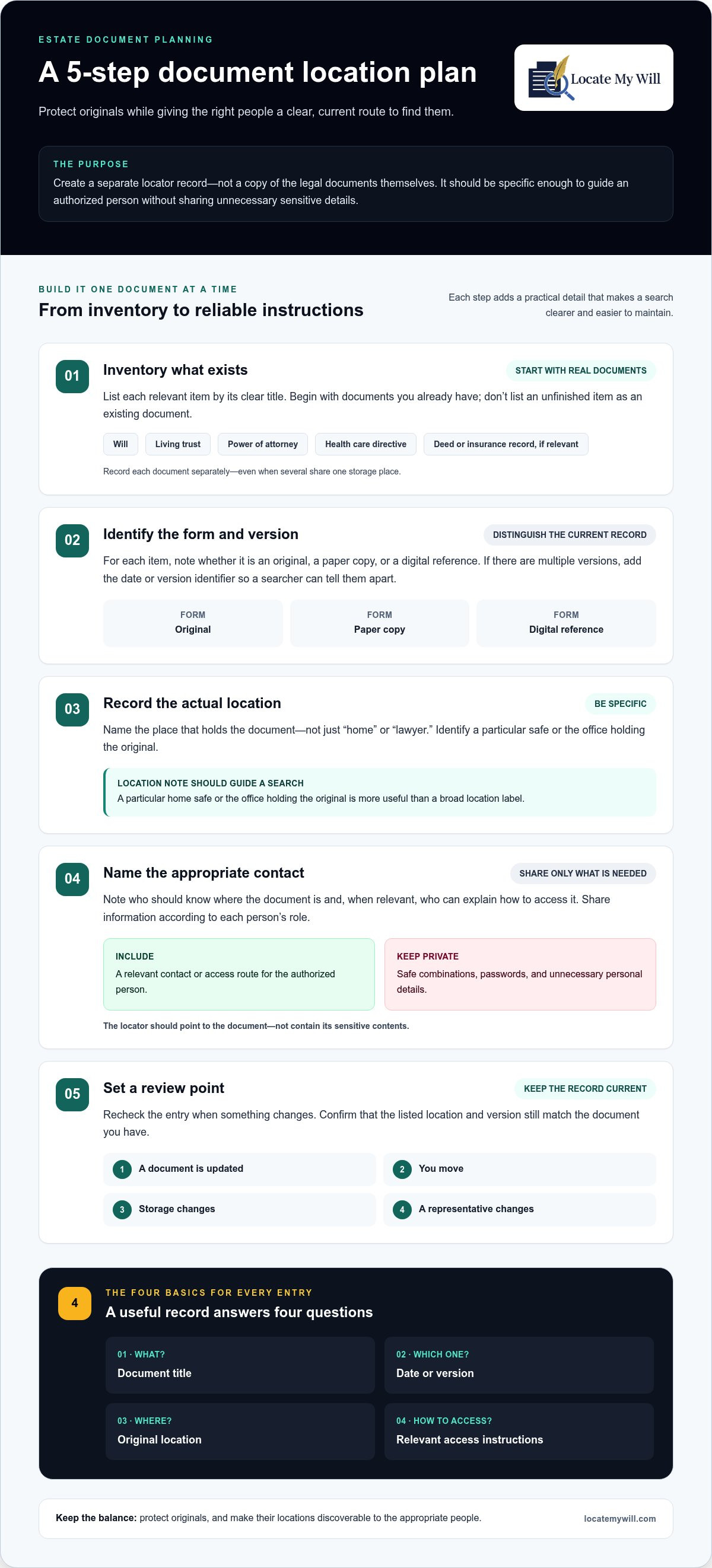
A useful plan is specific enough to guide a search, but it doesn’t need to reproduce private details from your legal documents. Build it one document at a time, and keep location notes separate from the documents themselves. This workflow turns a loose collection of papers and files into an estate planning document location record you can maintain.
Create a practical inventory before choosing storage
Begin with documents you already have. Note other records that may need attention, but don’t list an unfinished item as an existing document. Include related records, such as a deed or insurance policy, when they have a clear role in your household’s plan. Advice on storing estate planning documents also emphasizes considering both storage and how the people who may need the documents will learn where they are.
- Inventory what exists. List each relevant document by its clear title, such as “health care directive” or “living trust.” Add related records only when they support a specific part of your plan.
- Identify the form you have. Mark whether each item is an original, a paper copy, or a digital reference. If there are multiple versions, note the date or version identifier so a searcher can distinguish the current record from an older one.
- Record its location. Name the actual place, not just “home” or “lawyer.” For example, identify a particular home safe or the office holding the original. Make instructions clear enough to guide an authorized person without revealing combinations, passwords, or unnecessary personal details.
- Name an appropriate contact. Note who should know where the document is and, where relevant, who can explain the access process. Share only what each person needs to carry out their role. A locator should point to the document, not contain its sensitive contents.
- Set a review point. Recheck the entry after a document is updated, you move, storage changes, or a designated representative changes. Confirm that the listed location and version still match what you have.
Assign location and access details deliberately
For every entry, capture four basics: document title, date or version, original location, and relevant access instructions. A note might say, “Original will, signed May 2025, in the home safe; contact Jordan for access.” Keep details measured: “top shelf in the locked office cabinet” may be useful, while putting a safe combination in a broadly shared inventory can expose more information than necessary.
A useful document-location record names the document, identifies its current version, points to the original, and explains the appropriate route to access. Store the inventory separately from the originals and share it selectively with people you trust. If you want a dedicated way to record where your will is kept, Locate My Will’s will-location record can be one part of this broader plan.
Compare Estate Document Storage Options by Protection and Access
No single storage method suits every document or household. Compare how well an option protects the original with how easily you or an appropriate representative could locate it and understand the access process. Your estate planning document location plan can combine methods, such as keeping an original in one place and a reference copy elsewhere.
| Option | Protection | Everyday access | Representative access | Maintenance considerations |
|---|---|---|---|---|
| Home filing cabinet | Convenient, but protection from theft, fire, or water depends on the cabinet and its surroundings. | Usually straightforward for the household. | Depends on clear directions and suitable access arrangements. | Update the locator if papers are moved, reorganized, or replaced. |
| Home safe | May add a layer of protection, but safes differ. Don’t assume identical resistance to fire, water, or theft. | Accessible to people who can open it. | A representative needs to know where it is and how access is arranged. | Keep key or combination management information current, but don’t put the key or combination in a broadly shared locator. |
| Safe deposit box | Provides secured bank storage, though the bank’s procedures and the box’s contents may have specific limitations. | Access depends on the bank’s availability and account procedures. | Access may not be immediate or automatic. A box could be subject to additional procedures after the owner’s death. | Review authorized access arrangements and verify applicable state procedures for important originals. |
| Attorney’s office | Depends on the office’s document-handling arrangements and whether it holds the original or a copy. | May require contacting the office and following its procedures. | A representative needs accurate office and contact details, and must follow applicable access requirements. | Update the record if the document, office, or contact information changes. |
| Digital reference copies | Protection depends on the account and device safeguards used. | Can be convenient for someone with authorized access. | Access depends on the account’s permissions and the person’s ability to use them. | Keep copies current and clearly label them as references if they are not originals. |
When home storage may fit the plan
A filing cabinet can make papers easy to retrieve, while a home safe may provide additional protection depending on its design and placement. Neither is automatically right for every original. Convenience depends on practical details: a representative must know which room or safe to look for and have an appropriate way to gain access. Record where keys or combinations are managed, not the sensitive details themselves.
When storage outside the home deserves consideration
A safe deposit box or professional office can separate documents from everyday household storage, but each has its own access procedures. Before placing an original there, understand how an authorized representative could locate and request it. State rules and procedures may affect access, so verify the details that apply to your situation rather than assuming rights or timing are the same everywhere. Digital copies can help someone identify what a document says, but don’t assume a reference copy replaces an original. Choose based on the document, your circumstances, and a workable access plan.
Keep Estate Document Locations Accurate as Life Changes
A location plan is useful only if it reflects your current documents, people, and storage arrangements. Outdated notes can send a searcher to a former address, a previous custodian, or an older version of a document. A brief review after key changes keeps the record dependable without requiring you to rebuild it from scratch.
Review your location plan whenever a document, representative, address, or storage arrangement changes. Use these events as prompts:
- You move: Check whether documents stayed in the same place or went with you. Replace old addresses and directions.
- You revise a document: Confirm the date or version in the location record matches the current document, and clarify what happened to earlier versions.
- You change representatives: Update who should be informed and who may need access instructions. Remove details that no longer apply.
- You change storage: Verify that each listed document is actually at the new location and update any related access guidance.
Use life events as review prompts
During each review, verify that every listed document still exists, note whether it is an original or reference copy, and confirm that it remains where the record says it is. If a document has moved or been replaced, revise the entry rather than adding a second instruction that conflicts with the first.
For example, a note may point to a will held at a former attorney’s office even though the original has since been returned to the owner. Keep one current instruction and clearly mark obsolete records as superseded or remove them from active use. That reduces the chance that someone will follow an outdated lead.
Make instructions useful without oversharing
Write location notes in plain language. Identify the document and the place to begin, then state whom to contact for procedural questions. A locator might say, “Current health care directive, original in the home office cabinet; contact Morgan about access.” It doesn’t need to include the document’s private contents, account details, or a safe combination.
Keep a controlled backup of the location instructions in a separate place from the originals. Limit it to the people who need the information, and avoid creating unnecessary copies of sensitive document contents. If you keep more than one locator, identify which record is current and update all copies together. A dated review note can help distinguish the latest version from an older one.
For your will, you can also maintain a location record through Locate My Will’s will-location platform. It records where the will is kept, rather than storing the physical document, and lets users designate authorized searchers and notification recipients. Keeping that record aligned with your broader inventory helps make instructions clear as circumstances change.
Record Your Will’s Location With Locate My Will
A broader estate planning document location plan may include wills, trusts, directives, and other records. Locate My Will addresses one specific part of that plan: it’s a subscription-based platform where users record where their will is kept. It records the will’s location; it doesn’t store the physical document or host a digital will. You choose where the will itself belongs, then maintain a separate location record to help the right people know where to look.
How the will-location record supports a broader plan
Think of the will record as a focused reference that complements your inventory for other estate documents. Your separate inventory can track a trust, power of attorney, or health care directive and where each is held. Locate My Will provides a way to record the will’s location and manage designated searchers and notification recipients.
Users can designate up to three authorized searchers and up to three notification recipients. These roles are distinct: only verified searchers can access the recorded will-location information. Search activation dates control when searches can be performed and notifications sent. Consider who should be designated and choose activation dates that reflect your plan, rather than assuming everyone listed has the same access.
For details on the registration process, consult the article’s guide to registering a will’s location online. Keep any registration information consistent with your wider inventory, especially after moving the will or replacing it with an updated document. A location record works best as a current pointer to the will, not as a substitute for organizing other estate records.
Choose a clear next step for your plan
Start by identifying where your current will is kept and whether you’re referring to the original or another copy. Then consider who should be able to search for its recorded location, who should receive notifications, and when searches and notifications should become active. Revisit those choices if the will moves or the people in your plan change.
A few deliberate decisions can make the will’s location easier to communicate without confusing a locator with document storage. Keep the physical will in the place you have selected, and use the location record to direct an appropriate searcher there. This separation helps preserve a clear boundary between safeguarding the document and managing access to its location information.
If you’re ready to make the will’s location easier for authorized people to find, create a Locate My Will record and keep it aligned with your broader estate document plan.
Make Your Next Estate Planning Step Clear
Good planning is less about anticipating every possibility than about making today’s intentions easier to follow. A clear estate planning document location record gives your chosen representatives a practical starting point while leaving you in control of what information you share and with whom.
You don’t need to resolve every detail at once. Begin with one deliberate step: confirm where your will is kept, then choose how its location should be recorded. A simple, considered action can make your wider plan easier to carry forward as your circumstances change.
Create a clear record of your will’s location with Locate My Will. Make the will’s location easier for authorized people to find with a record that fits into your wider estate plan.
Frequently Asked Questions
Can a safe deposit box hold all of my estate planning documents?
A safe deposit box may suit some originals, but it isn’t automatically the right place for every document. Consider how quickly an item might be needed and what steps a representative would have to take to reach it. For example, a document used during a health emergency may call for a different access plan than a record intended for later reference. Note the box’s existence and access process, and consult a qualified attorney about state-specific questions.
Is a scanned copy of a will as good as the original?
A scan can help someone read the will or identify details while searching, but don’t assume it has the same legal effect as the signed original. The consequences of a missing original can depend on the circumstances and applicable state law. Keep a clear record of where the signed document is held, and distinguish any scan from the original in your inventory. For guidance about a particular will, speak with a qualified attorney.
Can an executor access a safe deposit box after someone dies?
Access depends on the account arrangement, the institution’s procedures, available documents, and applicable state rules. Being named executor in a will doesn’t necessarily mean someone can open the box immediately. Record the institution and box information in your estate planning document location plan, but keep keys, combinations, and other sensitive details controlled. If access is expected to be important, clarify the relevant procedure in advance rather than relying on assumptions.
What happens if the person named as executor cannot serve?
The next step depends on the will and applicable state procedures. The document may name an alternate, but someone may need to establish who has authority before handling estate matters. Keep the will’s location information current and make sure the relevant people know how to begin the search. If the named executor becomes unavailable, a qualified attorney can explain the process for that specific estate and jurisdiction.
Should I include account passwords in my estate document location record?
No. A location record should help someone find a document, not become a general list of passwords or account credentials. For example, note that a particular device or account contains relevant records without putting its login details in a widely shared inventory. Manage credentials through a separate, appropriately secure process, and limit access according to each person’s role. Revisit those arrangements when accounts, devices, or designated representatives change.
Do estate planning documents need to be kept in one place?
No. Different documents may suit different storage arrangements, and a will, insurance record, and health care directive don’t have to share a folder. The practical requirement is a current way to identify each item and find it. For instance, a separate entry for a directive can prevent it from being overlooked when it’s stored apart from the will. Keep copies and originals clearly distinguished so searchers know what they’ve located.
Can a probate court keep my original will before I die?
There isn’t one national answer. Court procedures and available options vary by state and jurisdiction, so check the relevant court’s official guidance or speak with a qualified attorney before relying on court lodging. If you use this option, document the court and any identifying details needed to locate the will. Keep that location information current, especially if you later retrieve the document or change where it is held.


