

A missing will can turn uncertainty about a person’s wishes into disagreements over property and personal belongings. Preventing family disputes over a missing will starts with clear estate-planning instructions and making sure the people who need them can locate the will. In Ohio, Ohio Revised Code Section 2105.06 governs intestate succession, according to the Ohio General Assembly.
It’s understandable to assume a will alone will prevent conflict. But clarity about who inherits each asset, who will administer the estate, and where the will is recorded also matters. This article explains how estate planning can reduce ambiguity and how questions about a will’s validity may affect family disagreements.
You’ll learn practical ways to clarify intentions, coordinate a will with other asset arrangements, and keep its location easy to find. Organized preparation can leave family members with fewer unanswered questions when it matters most.
Key Takeaways
- Discuss how assets should be divided and record specific gifts clearly to reduce ambiguity among family members.
- If an original will is missing, organize the information available about its location and the steps taken to find it.
- When considering a copy, focus on evidence that may establish both the will’s contents and its authenticity.
- Use Locate My Will’s Will Owner Registration Subscription to record where a will is located and manage authorized searchers and search activation dates.
1. How Can Estate Planning Prevent Family Disputes Over Assets?
Estate planning gives family members written instructions instead of leaving important decisions open to interpretation. Without a will or trust, relatives may disagree about dividing property, real estate, and personal belongings. In Ohio, Ohio Revised Code Section 2105.06 governs intestate succession, according to the Ohio General Assembly. Intestacy means the estate is distributed under state rules rather than the deceased person’s written wishes. For Ohio families, preventing family disputes over a missing will begins with making the plan’s location and instructions clear.
A clear will can identify who inherits each asset and name an executor to administer the estate. Specific bequests clarify who should receive meaningful belongings. For example, naming the intended recipient of a particular piece of jewelry can prevent competing assumptions among beneficiaries. A general instruction to divide personal items may leave relatives debating what the person intended. Another practical part of preventing family disputes over a missing will is making sure the people who may need it know where its location is recorded.
Blended families can face added uncertainty when a plan does not address biological children, stepchildren, and a surviving spouse. State clearly in a will or trust how each group should be treated. For example, explain whether a spouse receives assets outright or through a trust. Caregiving, financial assistance during life, or a beneficiary’s special needs may also help explain unequal inheritances. Recording the reasons for a significant change can help relatives understand the decision.
Family disagreements can also arise when relatives question whether a will reflects the person’s wishes. Lack of mental competence and undue influence may become grounds for a challenge. Proper execution under applicable state law supports the document’s authenticity. A person making a will should understand that they are creating a will, the general nature and value of their assets, and how the will distributes property. Document the reasons for major changes and keep detailed notes from estate-planning meetings.
Coordinate beneficiary designations with the will. IRAs, workplace retirement plans, life insurance policies, annuities, and payable-on-death bank accounts may pass according to their named beneficiaries. Review those designations after marriage, divorce, a death, or a birth or adoption. In Ohio, most will contests must be brought within three months after the executor files notice of the will’s admission to probate, according to the Ohio General Assembly. Clear records and consistent instructions can reduce conflicting expectations.
3. What should you do if an original will is missing after someone dies?
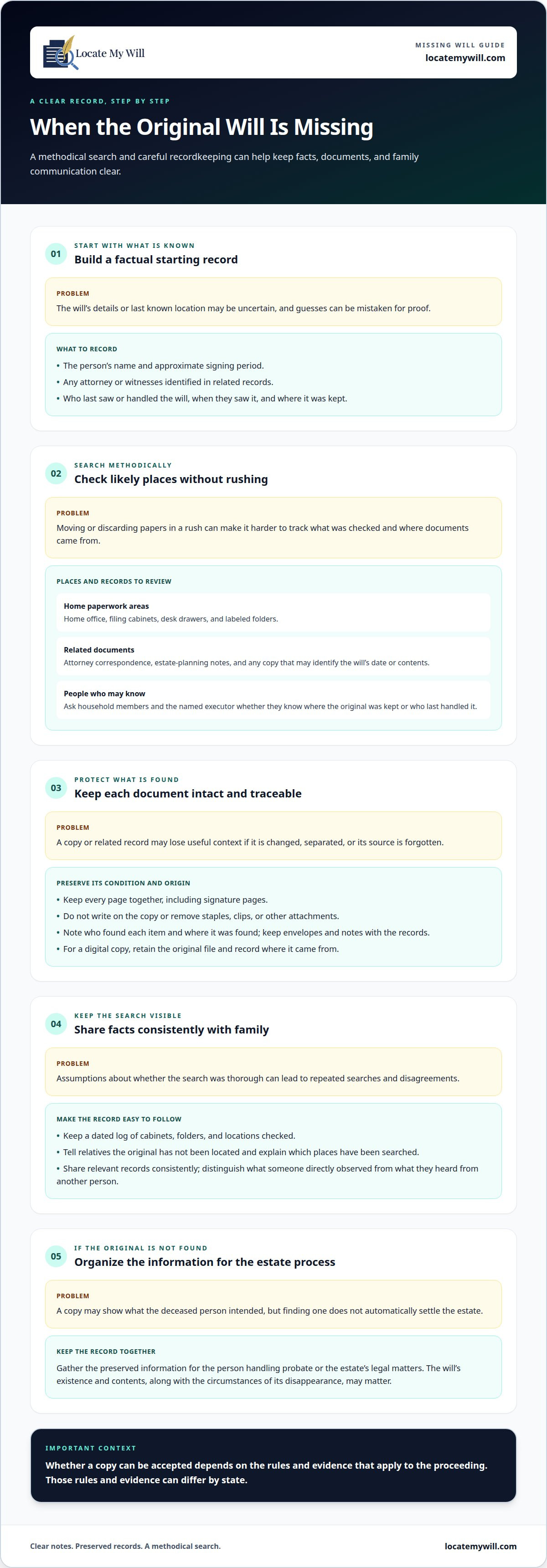
Start by preserving any information that could identify the will and its last known location. Ask the person who handled the deceased person’s paperwork, such as an executor named in another document or a close family member. Record each person’s account, including when they last saw the will and where it was kept. Keep these details factual, and don’t treat a guess about its location as proof.
Search methodically rather than moving or discarding papers in a rush. Check the deceased person’s home office, filing cabinets, desk drawers, and labeled folders. Look for correspondence from an attorney, estate-planning notes, or a copy that may identify the document’s date and contents. If a family member finds a copy, keep it intact and note who found it and where.
- Write down the will’s known details, including the person’s name, approximate signing period, and any attorney or witnesses identified in related records.
- Ask household members and the named executor whether they know where the original was kept or who last handled it.
- Review papers and correspondence for references to a safe, filing location, attorney meeting, or later revision.
- Preserve copies, envelopes, and notes together, and record where each item came from.
Keep family communication measured. Tell relatives, for example, that the original has not been located and explain which places have been searched. Share relevant records consistently instead of letting one person’s assumptions shape the discussion. A dated search log can show which cabinets, folders, and locations have been checked, reducing repeated searches and disagreements about whether anyone looked carefully.
If the search does not locate the original, gather the preserved information for the person handling probate or the estate’s legal matters. The will’s existence and contents, along with the circumstances of its disappearance, may become important. Separate what someone observed directly from what they heard from another person. This distinction helps keep the record clear as the family considers its next steps.
4. Can a copy of a will be probated if the original is lost?
A copy may help show what the deceased person intended, but finding one does not automatically settle the estate. The person handling probate can present it as part of the estate’s records. The court must determine whether it can be accepted under the rules that apply to the proceeding. Those rules and the evidence considered can differ by state.
Preserve the copy in its current condition. Keep every page together, including signature pages, and note who found it and where. Don’t write on the document or remove staples, clips, or other attachments. If the copy is digital, retain the original file and record where it came from. These steps help maintain a clear account of the document’s origin.
Next, gather records connecting the copy to the person who made the will. Useful material may include correspondence about preparing or signing it, an attorney’s file, or notes identifying people who were present. Keep each record’s source clear. For example, distinguish a witness’s direct recollection of the signing from a relative’s account of what someone else said.
Also establish what happened to the original. Search records for references to where it was stored or whether it was later revised, and document the locations already checked. The circumstances matter because a missing original can raise questions about whether it was intentionally revoked or simply misplaced. Don’t treat its absence alone as proof of either explanation. Preserve evidence supporting each account without altering or selectively distributing documents.
Present the copy and related records together to the person managing the probate filing. Keep a separate inventory of each item, its source, and the date it was found. Give relatives consistent information, rather than different versions of the copy or its history. A copy can be relevant, but whether it is admitted depends on the applicable probate process and evidence presented. A clear record helps the court assess the document and gives family members a shared factual basis for discussion.
4. What evidence is needed to prove a lost will and its contents
Evidence should help establish what the will said, whether the deceased person signed it, and how the original went missing. Exact legal requirements vary by state. Begin with the most complete copy available, including every page, signature block, and attachment. Preserve the file or paper as found, and note who located it and where.
Witnesses may provide firsthand information about the will’s signing and the person who made it. Record each witness’s name and what they personally remember, such as who attended or whether the document was signed. Separate direct observations from later conversations. A witness who saw the signing can offer a different kind of evidence from a relative who only heard about it afterward.
Records connected to the will’s preparation can help establish its history. Collect correspondence with an attorney, appointment notes, drafts, and messages discussing changes or intended beneficiaries. Keep dates and sources attached to each item. For example, an email referring to a revised gift may help explain why an earlier draft differs from the copy being presented.
The circumstances surrounding the original’s disappearance also matter. Write down where it was last kept, who had access, and which locations were searched. Preserve any notes or messages about moving, replacing, or revoking the will. Don’t assume a missing original proves it was revoked; document what each person knows instead.
Prepare an organized evidence file for the person handling the estate’s probate process. Include the copy, witness contact details, preparation records, and a dated search log. Label each item with its source, and avoid altering original papers or digital files. This makes it easier to distinguish the will’s contents from assumptions about its history. For future planning, record where your will is kept so authorized people can locate it.
An original that cannot be found does not by itself establish that the will was revoked. Document the circumstances of its disappearance as well.
Locate My Will: Will Owner Registration Subscription
Locate My Will helps you record where your will is kept, giving authorized people a clear starting point when they need to locate it. The Will Owner Registration Subscription lets you enter the will’s location and manage designated searchers and notification recipients. You can designate up to three authorized searchers and three notification recipients.
Authorized Searcher Management lets you manage who may search, while Search Activation Date Control lets you set when searches can be performed and notifications sent. This helps organize access instructions in advance, rather than relying on relatives to guess where the document is.
To make your will’s location easier to find, start a Locate My Will subscription and record where the will is kept.
Make the next step part of your estate plan
Give your preparation a clear handoff. Decide who should know that a will-location record exists, and make sure that person understands their role. A short, calm conversation can prevent relatives from relying on assumptions or searching without knowing where to begin. Keep the arrangement aligned with your wishes as circumstances change.
Preventing family disputes over a missing will also means making the practical details understandable to the people who may need them. Choose a moment to review your arrangements, confirm that the information remains useful, and tell the appropriate person how to proceed. Clear instructions can give loved ones a more organized starting point during a difficult period.
If you’re ready to put a will-location plan in place, contact Locate My Will. A deliberate step today can help your family approach future responsibilities with greater clarity and care.
Frequently Asked Questions
How Can Estate Planning Prevent Family Disputes Over Assets?
Estate planning gives relatives a shared reference point for decisions that might otherwise rely on memory or assumptions. Decide who will communicate with family members and where they can find current instructions. For example, a family can agree that the named representative will share the same estate information with each beneficiary, reducing confusion about who has been told what.
How Can a Simple Will Prevent Family Conflict After a Death?
A simple will can make a person’s intentions easier to understand through consistent names and precise descriptions. Identify people clearly, and avoid labels such as “my closest relative” when several people could fit. For personal items, a separate, clearly referenced inventory can help distinguish one possession from another. Review the wording after family or ownership changes so the instructions remain clear.
What Causes Most Family Disputes Over an Inheritance?
Disputes often begin with conflicting expectations, unclear instructions, or disagreement about whether a decision reflects the deceased person’s wishes. One relative, for example, may remember a promise about a family heirloom while another relies on written instructions. Tension can also arise when family members receive different information about estate administration. Keep communications factual and consistent to avoid turning assumptions into competing claims.
How do state laws handle a lost or missing will in the United States?
State law governs how a probate court considers a missing will, so the process differs across the United States. Courts may assess evidence about the document’s contents, execution, and disappearance under the applicable rules. If no will is accepted, the estate may be handled under that state’s intestacy rules. The deceased person’s state and the available records matter.
How can families locate a missing will, including checking with the probate court or attorney?
Ask the probate court whether a will has been filed in the deceased person’s estate, and contact the attorney who prepared or discussed estate documents. Provide the person’s full name and any known details that may help identify the matter. Ask the executor and close family members about the document’s last known location, too. Record who you contacted and what each person reported.
How should families preserve and share estate documents to prevent disputes over a missing will?
Choose one person to maintain an organized index of estate records, noting each item’s source and date received. Keep originals in their existing condition and share clear copies with relevant family members through a controlled method. Avoid editing scans or adding notes to original papers. If relatives disagree about a document, refer to the same copy and record specific questions separately for follow-up.


