

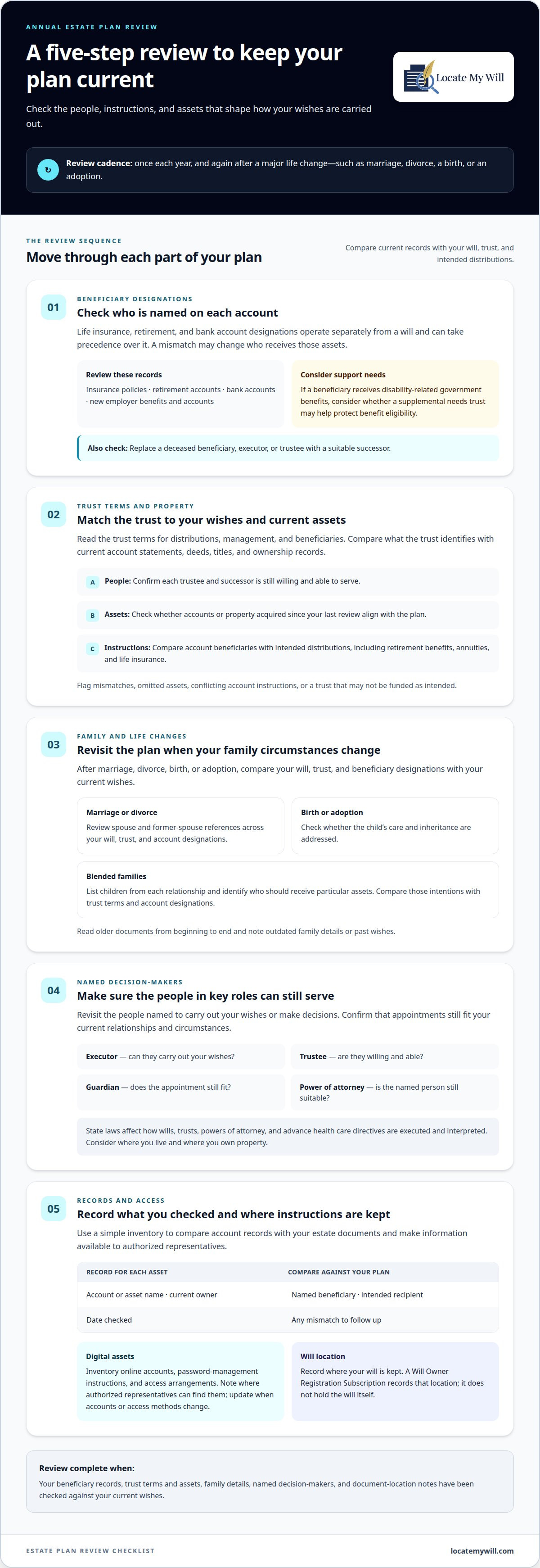
An estate plan can stop reflecting your wishes as the people and circumstances in your life change. An annual estate plan review checklist should cover beneficiary designations, trust terms, major life changes, and the people named to make decisions or carry out your wishes. Review these details each year and after a major change, such as marriage, divorce, a birth, or an adoption.
It’s easy to assume a signed plan will remain suitable over time. A deliberate review can help you spot details that need attention, such as an outdated beneficiary or a decision-maker who can no longer serve. This checklist shows what to revisit and why each item matters.
Review beneficiaries and trust details, consider how life changes affect your plan, and revisit named decision-makers such as executors, trustees, guardians, and people with powers of attorney. You’ll also see how to keep track of your will’s location so the people you authorize can find that information when needed.
Key Takeaways
- Review beneficiary designations alongside your will, especially when a loved one’s support needs may affect how they receive an inheritance.
- Check that trust terms, trustees, beneficiaries, and assets still reflect your intentions.
- Revisit your plan after marriage, divorce, a birth, or adoption so new family circumstances are accounted for.
- Confirm that your named decision-makers, including executors, trustees, guardians, and people with powers of attorney, can still serve.
Planning for beneficiaries with special needs or disabilities
Review each beneficiary designation alongside your will, especially when a loved one receives disability-related government benefits. Beneficiary designations on life insurance, retirement, and bank accounts take precedence over a will, so a mismatch can change who receives those assets.
- Compare life insurance beneficiaries with your current wishes; a policy names recipients separately from your will.
- Review retirement account beneficiaries after opening an account or changing employers; new forms may name different recipients.
- Check bank accounts with beneficiary designations, since those instructions also operate outside your will.
- For a beneficiary receiving government benefits because of a disability, review whether a supplemental needs trust may help protect benefit eligibility.
- Replace a deceased beneficiary, executor, or trustee with a suitable successor; a role left unfilled may not reflect your current plan.
- Review new employer benefits and accounts after a job change, since enrollment can create new beneficiary records.
Use an annual review to compare account statements, insurance policies, and employer benefits records with your estate documents. Note each account, its named beneficiary, and the date you checked it. If a beneficiary needs ongoing support, consider how an inheritance will be managed, not just who receives it.
According to the Internal Revenue Service, the U.S. federal annual gift tax exclusion was $17,000 per recipient in 2023. According to the Internal Revenue Service, estates of decedents who die during 2021 have a basic exclusion amount of $11,700,000, up from a total of $11,580,000 for estates of decedents who died in 2020.
State laws affect how wills, trusts, powers of attorney, and advance health care directives are executed and interpreted. Review whether your documents and named decision-makers still fit the state where you live and any state where you own property.
For digital assets, make an inventory of online accounts, password-management instructions, and access arrangements. Note where authorized representatives can find the instructions, and update them when accounts or access methods change.
Reviewing trust terms, trustees, beneficiaries, and assets
Compare your trust document with the assets you currently own and the distributions you intend. A trust addresses assets connected to it as planned, so review account records, property titles, and any schedules identifying trust property. If you acquired an account or property since your last review, confirm that its ownership aligns with your plan.
- Read the trust terms and confirm they still match your wishes for distributions, management, and the people who benefit.
- Review each named trustee and successor; consider whether they remain willing and able to carry out the responsibilities.
- Compare the trust’s asset list with current statements, deeds, and ownership records, then note any mismatch for follow-up.
- Check each account’s beneficiary instructions against your intended distribution, because rules differ by asset type.
- Review retirement benefits, annuities, and life insurance to see whether a revocable trust is named as payable-on-death beneficiary as intended.
- Confirm that assets intended for heirs are not directed elsewhere through a conflicting account designation.
Use an annual estate plan review checklist to inventory each asset’s name, current owner, beneficiary, and intended recipient. Compare the inventory with your trust document and account records, then flag discrepancies. This can reveal an account omitted from the trust plan or an outdated designation that directs funds differently.
Common mistakes include assuming a will controls every asset, overlooking an unfunded trust, and leaving inconsistent beneficiary instructions in place. Your annual estate plan review checklist can help identify trust terms or trustee appointments that no longer match your intended plan.
After reviewing the documents, record where your will is kept so its location is available to the people who need it. A Will Owner Registration Subscription helps record that location; it does not hold the will itself.
Revisiting plans after marriage, divorce, birth, or adoption
Marriage, divorce, birth, and adoption can change whom you want to protect and provide for. After each event, compare your will, trust, and beneficiary designations with your current family circumstances. For example, a new child may need care and inheritance provisions that your existing documents don’t address.
- After marriage, review whether your spouse should be included in your will, trust, and account designations.
- After divorce, revisit beneficiary designations, wills, and trusts so they reflect your current wishes.
- After a birth or adoption, review provisions for the child’s care and inheritance.
- In a blended family, list children from each relationship and identify who should receive particular assets.
- Review any guardian, executor, or trustee appointments affected by a change in family relationships.
- Read older documents from beginning to end and note references to former spouses, outdated family details, or past wishes.
In a blended family, don’t assume a general instruction will make your intended distribution clear. Specify which children or other relatives you want to include, then compare those intentions with trust terms and account designations. A child named in an older document may not fit your current plan.
How often should you update a will, trust, and other estate planning documents? Review them annually and after major life changes, including marriage, divorce, birth, or adoption. An annual review helps you assess whether your documents still reflect your wishes and circumstances.
For older plans, check when you last reviewed them and whether the named people, family details, and asset instructions remain accurate. Mark each document that needs attention, then keep your review notes with your estate planning records. A change in family structure can make even a carefully prepared plan worth revisiting.
Reviewing key people named in an estate plan
A decision-maker’s role should fit your current needs and the authority assigned in your documents. Review each appointment separately instead of treating “the people in my plan” as one list. Check whether each person is living, reachable, willing to serve, and able to handle the specific responsibility. If someone has died or can no longer act, name a replacement in the appropriate document.
- Executor: Confirm this person can handle estate administration and understands where relevant records are kept.
- Trustee: Review whether the person can manage trust assets and follow the trust’s distribution terms.
- Guardian: Consider whether the named person remains an appropriate choice to care for minor children.
- Agent under a power of attorney: Confirm this person remains suitable to make financial decisions under your instructions.
- Health care agent: Check that the person can communicate your preferences using your advance health care directive.
- Successor: Review each backup appointment, since a first choice may be unable to serve when needed.
For 2026, federal estate tax exemption amounts were scheduled to decrease to $5,000,000 per individual and $10,000,000 per married couple, adjusted for inflation since 2011. The Internal Revenue Service states the federal estate tax rate is 40%. State rules may also affect planning, so include your state of residence and any state where you own property in your review.
Review costs depend on the plan’s complexity, documents, assets, and the revisions needed. Consider consulting an estate planning attorney if a major change, tax concern, trust issue, or move between states affects your plan.
Include your will, trust documents, powers of attorney, advance health care directives, beneficiary designations, and asset records. Compare each document with your current appointments and wishes.
After confirming your representatives, make sure they can locate your will when necessary. Record your will’s location so authorized searchers have that information.
Locate My Will: Will Owner Registration Subscription
Locate My Will offers a Will Owner Registration Subscription to record where your will is kept, so authorized people can find its location when needed. The platform records the location, not the will itself. This can be a useful next step after reviewing your documents and confirming who may need to locate your will.
Through the platform, you can manage up to three authorized searchers and three notification recipients. Search Activation Date Control lets you set when searches are enabled and notifications can be sent. You can revisit these details when your will’s location or your chosen representatives change.
To record your will’s location and manage who is authorized to search, visit Locate My Will to learn more.
Keep Your Plan Ready for the Next Change
Treat the annual estate plan review checklist as a recurring appointment, not a task reserved for major transitions. After each review, record the date, decisions made, documents needing attention, and next steps. Keep these notes with your current estate records so your next review can build on a clear history rather than memory.
Some updates involve straightforward recordkeeping. Others may affect how your wishes are expressed or how assets are distributed. Note which items need further attention, assign a next step, and revisit unresolved points at your next review. A consistent process helps keep decisions visible as circumstances evolve.
Choose a time for your next review and make it easy to find the information your representatives may need. To take a practical next step with your will’s location, contact Locate My Will. A clear record today can help you approach future planning with greater confidence.
Frequently Asked Questions
What life events should trigger an estate plan review?
Review your estate plan after marriage, divorce, a child’s birth or adoption, or the death of someone named in your plan. Changes in family relationships can affect whom you want to benefit or appoint. Note the event, then compare your current documents and account records with your wishes before deciding what needs updating.
How do you review and update beneficiaries on retirement accounts and life insurance?
List each retirement account and life insurance policy, then find its current beneficiary record. Compare the names and shares with your present intentions, including any contingent beneficiaries. If you want to make a change, use the account or policy provider’s beneficiary process and record the submitted designation. Recheck the record afterward to ensure your notes match the provider’s current information.
How should you check whether your executor, trustee, and powers of attorney are still appropriate?
Review each appointment by role, not just by name. Consider whether the person is living, reachable, willing to serve, and familiar with your priorities. For example, someone who can manage financial records may not be the right choice for every responsibility. Confirm that each document names a suitable successor, and note any appointment that needs a fresh decision.
What should you review about guardianship nominations for minor children?
Consider whether each nominated guardian remains suitable to care for your children and whether your family circumstances still support that choice. Think through practical matters, such as your children’s existing relationship with the nominee and the nominee’s ability to take on the role. Review any alternate nomination too, and note if your preferred choice has changed.
How do state laws affect wills, trusts, powers of attorney, and advance health care directives?
State laws affect how these documents are executed and interpreted. Review whether your documents and named decision-makers still fit the state where you live and any state where you own property.


